

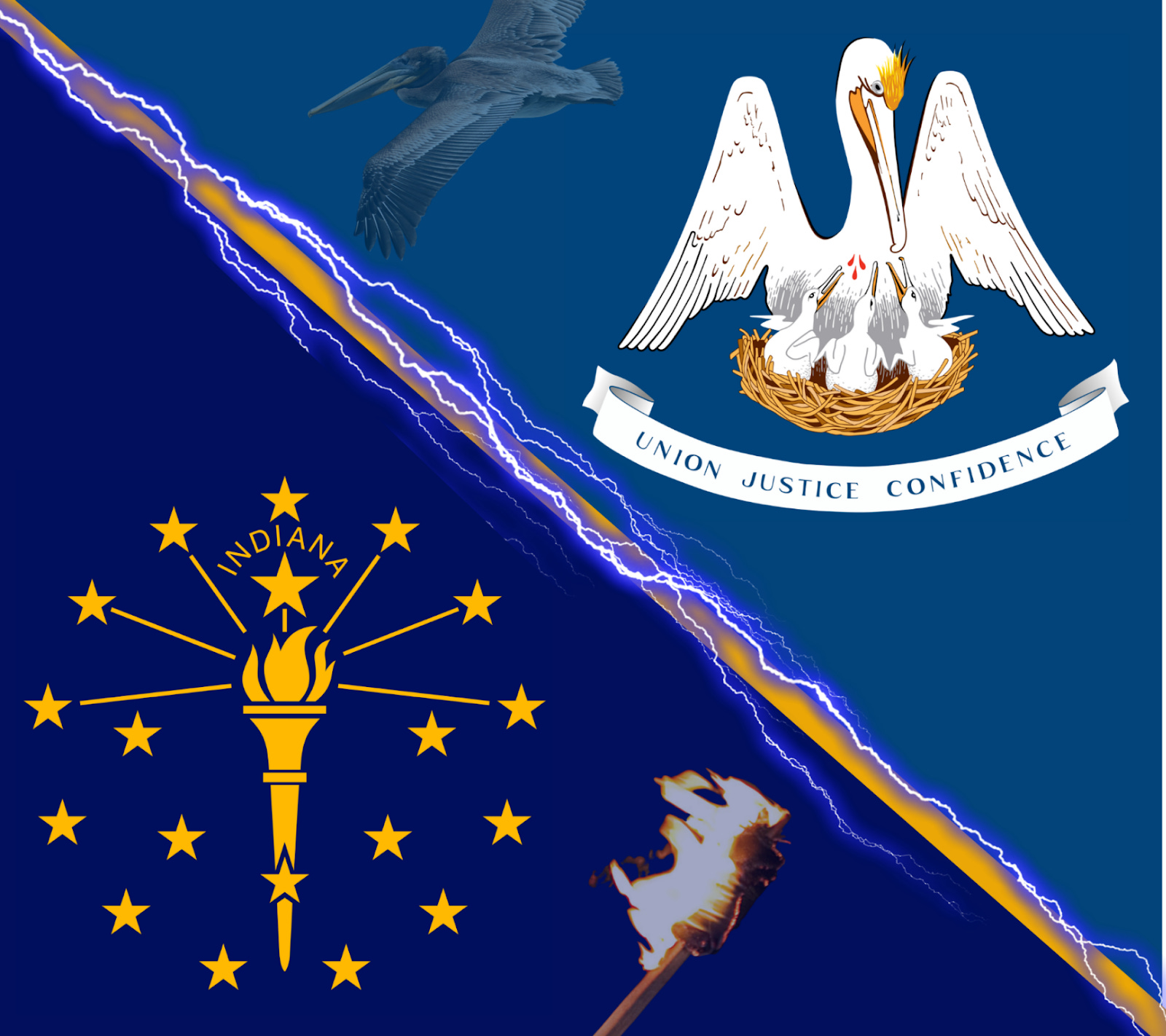
This is the fourth matchup post in our Elite Eight series. Read the full bracket announcement here.
Intro: Clash of the Titans
The geographical arrangement of our bracket means we have our two heaviest hitters in terms of SES-adjusted NAEP scores in this final Elite Eight matchup. These two states have spent the last decade or so proving many skeptics wrong: mentioning Louisiana’s educational successes still too-frequently raises eyebrows, and Indiana outperforms blue-state neighbors that spend considerably more per pupil.
But who wins on the fine-grained measures when we start to get specific?
Evidence-Based Instruction
Indiana and Louisiana both have fantastic track records on early literacy legislation aligned with the Science of Reading, each scoring an 18 of 18 on their ExcelinEd implementation reports. Both states require all K–3 teachers to complete SoR training and pass an SoR-aligned test for licensure. Louisiana was the very second state to prohibit three-cueing and Indiana legislated a ban of its own the following year.
While ExcelinEd gives Louisiana a slight lead over Indiana on Full Implementation, 9-7, what really sets these states apart is the way they approach getting High-Quality Instructional Materials into schools. First, everyone should go read Karen Vaites and her brilliant work on how Louisiana and Co. made the Southern Surge happen. (It goes way beyond phonics!1) Louisiana started rigorously reviewing curriculum in 2013 and issued state contracts to vendors whose materials met their standards, making HQIM both cheaper and easier for districts to adopt. The state also created its own free Guidebooks and developed thorough, curriculum-specific teacher training — all years before those additional SoR accomplishments. Now, in addition to being one of just two states using “book-rich, knowledge-curriculum statewide,” Louisiana is the only state whose 4th-grade reading NAEP scores actually improved through the pandemic (2019–’24). All this was done without curriculum mandates!
By contrast, Indiana does require its districts to use approved curriculum from state-approved lists. Although this means ELM’s methodology grants Indiana a “Full” on HQIM and Louisiana only a “Partial,” a bit more subtlety is needed. Curriculum mandates, while a powerful tool, are only as strong as a state’s approval list. Look at the most common K–5 reading curricula in Indiana:
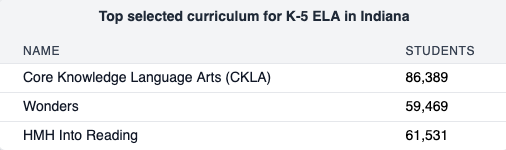
Although the most common, CKLA, is a content-rich, “knowledge-building” curriculum, Wonders and Into Reading are “basal readers,” lighter on content and with few actual books. Yet both of the latter still make it onto IDOE’s Advisory List!
Indiana remains a great state for evidence-based instruction, and would have the superior policy infrastructure in most other matchups. But against Louisiana, who started early and earnestly and is seeing that investment pay off, being “great” just isn’t enough. With masterful form, Louisiana wins on EBI.
Assessments & Accountability
While both states administer statewide assessments in core subjects, only Louisiana maintains a high-school assessment students must pass for graduation.
Indiana administers regular statewide assessments: ILEARN covers certain core topics (math, sciences, among others) and extends into some high school topics (government, biology) and IREAD covers foundational reading skills through the Grade 6 level. In principle, the ILEARN assessment is the core state accountability measure for elementary and middle schools, which drive local A–F school ratings based on performance. But Indiana has not given out school grades since 2018.2 Thankfully, the State Board of Education has just adopted a new accountability system set for the 2026–27 school year featuring revised A–F ratings, but the tradition still has nearly a decade of dust to shake off. Meanwhile, although taking the SAT is required for high school graduation, students need not reach a minimum score to pass; accordingly, statewide assessments in Indiana do not offer a true performance bar for certifying college readiness.
But they do in Louisiana! With the Louisiana Educational Assessment Program, or LEAP 2025, high-schoolers must take and pass three subject assessments in core categories to secure their diploma. As part of Louisiana’s revamped accountability system Grow. Achieve. Thrive, each school’s students’ LEAP 2025 performance then figures into their School Performance Scores, offering statewide feedback on student learning. (And pace Indiana, Louisiana’s accountability-system revamp did not follow years of hibernation.) All this amounts to a more consequential accountability structure than most states maintain.
Ultimately, LEAP 2025 and Grow.Achieve.Thrive give Louisiana stronger assessment tools and accountability levers than Indiana, and in turn they give an edge in this category.3
The Learning Environment: Policy vs. Practice
Policy-wise, both states are resisting some of the more popular, yet ineffective contemporary trends in school discipline reform. Neither Indiana or Louisiana has gone down the road of banning suspensions for young students, or mandating restorative justice as a prerequisite for removal.
But importantly, if we were grading states purely on student behavior, safety, and classroom order outcomes, neither Louisiana nor Indiana would score particularly well compared to the rest of the field. These are states where the classroom reality is rougher than most, even as their policy frameworks for dealing with it are sounder than many traditionally well-performing states’ now are. That tension is the backdrop for everything below. So: recognizing that both states are contending with more disorder than they were even five years ago, where do the details diverge?
Devices and Distractions
Louisiana moved first. In 2024, Governor Landry signed SB 207, banning students from having any electronic device on their person for the entire school day (with reasonable medical exceptions, etc.). Importantly, this ban included lunchtime, and any devices brought to school have to be turned off and stowed away for the day.
Indiana was, correspondingly, a step behind. A 2024 law banned phone use during instructional time, but left passing periods and lunch unregulated. Educators reported the partial ban was hard to implement, and so Indiana moved toward a stricter regime. In March 2026, Governor Braun signed SB 78, expanding the restriction to a full bell-to-bell ban. Well done to both Governors! Both states are now in strong positions on devices, but Louisiana had a full year head start, and Indiana’s stronger law doesn’t come into effect until the summer.
Discipline
Both Indiana and Louisiana law offer teachers and administrators broad authority to maintain classroom order by suspending or expelling students for disruptive misconduct or substantial disobedience; neither has the restrictive bans seen in some states on, e.g., willful defiance or young-grade suspensions.
Two noteworthy differences tip the scales southward. Although both states permit corporal punishment, Louisiana at least prohibits its use “for students with exceptionalities.” Louisiana law also adds explicit protection for teachers, preventing principals or administrators from prohibiting or discouraging school employees from taking disciplinary action consistent with policy, and also preventing them retaliating against employees for having done so. Local initiatives like Dads on Duty, based in Shreveport, also signal positive directions here for Louisiana.
Louisiana beat Indiana to the punch with its full bell-to-bell phone ban and maintains an edge on its approach to classroom order. Again, although the margins are close, they favor Louisiana.
Winner: Louisiana
Indiana is extremely competitive and easily remains our ‘gold standard’ for the Midwest. Without a doubt, in most other brackets Indiana would advance to our semifinals. Yet against such a strong opponent, Indiana falls just short. Louisiana is truly a phenomenal performer on evidence-based literacy instruction, and the state boasts strong enough education policy on other dimensions to complete a clean sweep. Hoosiers should be proud of what they have accomplished for their students, but nonetheless, Louisiana advances.
Related Articles


Karen Vaites covers Louisiana’s approach in depth and regularly; be sure to check her writing out!
“During the pause, schools instead received performance report cards posted online. The cards offered data on test scores, graduation rates, attendance, and postsecondary readiness, but stopped short of assigning a single letter grade.” From the Indiana Capital Chronicle.
Keep an eye out on Indiana’s ambitious plan to innovate with Indianapolis Public Schools. This legislation may improve accountability, though as yet it’s too early to tell.