

Nevada takes on Utah in the first round of the March Education Madness Elite Eight. If you missed the announcement post and the regional round results, give that a read here!
114°W
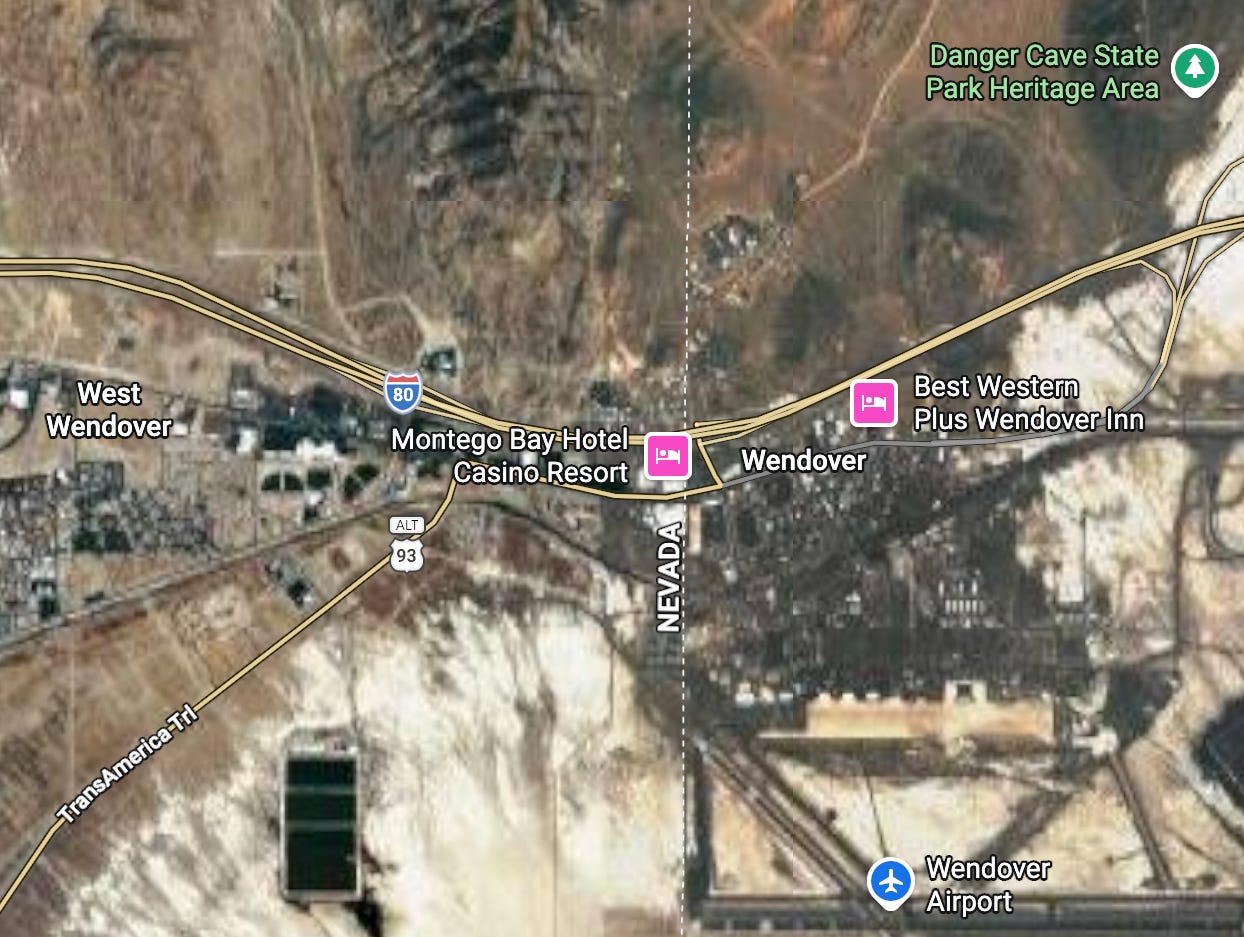
West Wendover, Nevada is the larger of two neighboring border cities straddling either side of the 114° west meridian. 2.3 miles eastward across the state line lies Wendover, Utah, a city with a similar demographic makeup but only a fourth of the population. Enrollment at West Wendover Elementary is just over twice that of Anna Smith Elementary; in both schools, the student body is more than three-fourths Hispanic, and a majority of children qualify for free or reduced lunch.
Many things are similar for the students in these communities, and the two schools are more like each other than either is to their own state’s “average” school. But despite their similarities, the state line means nuances in education policy that can make a big difference. ELL students benefit disproportionately from policies that promote phonics-based structured literacy, and students who decode in a second language are also those for whom three-cueing policies are most pernicious. Statewide policies on school discipline and phone use, meanwhile, are crucial for ensuring orderly classrooms with minimal distraction.
While schools like West Wendover and Anna Smith — high-ELL, high-FRPL, comparatively remote — often present unique challenges for policies on science of reading instruction, discipline, and phones, they are for the same reasons precisely the schools with the most to gain when good education policy is implemented at the statewide level.
For the first Elite Eight matchup in our March Education Madness, we’re taking a look at how the two states that meet along 114° west fare when it comes to providing the policy foundations for academic excellence. It’s rank 4 Nevada against rank 7 Utah — who will win?
Utah’s Early Lead in Evidence-Based Instruction
While both states have adopted evidence-based instruction policies aligned with the Science of Reading (SoR), Utah did so a full three years earlier than Nevada with the passage of SB 127 in 2022.1 This legislation checked several major boxes for evidence-based literacy:
First, SB 127 mandated SoR training for all K–3 teachers and administrators: existing K–3 teachers and admins were required to complete the LETRS training by July 1, 2025, and all new K–3 teacher candidates must pass the Utah Foundations of Reading Assessment (UFORA) to earn their licensure.
Second, SB 127 requires Utah’s local education agencies (LEAs) to provide and use state-approved, evidence-informed materials for core instruction and evidence-based materials for intervention. In addition, the law established the Early Literacy Repository, a regularly updated collection of SoR resources for teachers, admins, parents, and teacher preparation programs, and moreover provided SoR-trained literacy coaches to schools with low literacy performance.
Tellingly, in its 2024 “State Reading Policy Action Guide,” the National Council on Teacher Quality (NCTQ) singled out Utah as a premier example of how to implement effective reading instruction, citing the state’s SoR-aligned teacher preparation programs and its “clear, explicit standards for candidate knowledge and demonstration of skills specifically aligned to SBRI [scientifically based reading instruction].”
Now, in 2025 Nevada made major progress on multiple fronts. For one, the Nevada Department of Education released a revised State Literacy Plan formally adopting SoR for PreK–12 and emphasizing both multi-tiered support systems (MTSS) & structured literacy progression.
Then, adding legal teeth, the Nevada legislature passed SB 460, which aligned teacher preparation programs to the science of reading and required all K–3 teachers to complete SoR training. Yet despite this recent spurt, Nevada is still a ways off from narrowing the distance made by Utah’s head start. Because of SB 460’s training deadline for teachers — end of 2027–’28 school year if hired before 8/1/25, or within 3 years of starting if hired thereafter — it’s too soon to see the full fruit of Nevada’s new policy.
It is important to note, too, that while ExcelinEd’s (excellent!) Early Literacy Matters Implementation Reports credit Nevada with 14 out of 18 early literacy principles and Utah with only 12 of 18, these tallies count “full,” “partial,” and “future” implementation equally toward the total. Whereas Nevada’s two-point margin is attributable to its five future-implementation commitments, when it comes to full+partial implementation, Utah leads 12 to 9.
And now thanks to recent developments, three of Utah’s current “Not adopted” scores — dyslexia screening, three-cueing ban, and third-grade retention — are set for the “future” column. When it became clear that Utah was behind on SB 127’s goal of reaching 70% reading proficiency for third graders by 2027, state leaders redoubled their commitment. Inspired by Mississippi and other literacy leaders, legislators in early 2026 introduced SB 241, a bill that stands to implement a formal ban on three-cueing, mandated dyslexia screening, and third-grade retention for readers. Meanwhile, although Nevada introduced AB 187 (2023) to ban three-cueing, the bill never received a hearing and no such ban was adopted.
With a three-year head start on SoR policy implementation, a more comprehensive framework, and even more progress on the horizon, Utah wins on evidence-based instruction.2
A Close Contest for Discipline & Learning Environment
Effective learning requires a safe and orderly environment. Classroom distractions and disruptions, chronic absenteeism and misbehavior, and at worst, violence, all undermine even the best pedagogical and curricular policies.
In this final leg of the match, then, we’re going to compare how Nevada and Utah protect the learning environment along two policy dimensions: (1) discipline & classroom order, and (2) devices & classroom distractions. Each state has taken steps to tackle these two defining classroom environmental problems of the 2020s, but how do they size up?
Discipline
Back in 2019, the Nevada state legislature passed Bill No. 168, seeking to disrupt the “school to prison” pipeline by requiring schools to make “a reasonable effort to complete a plan of action based on restorative justice” with a pupil before removing them.
But a mere four years later, only one state legislator stood opposed to rolling back the 2019 restorative justice (“RJ”) law. It turns out that keeping the most disruptive and violent students in classrooms by forcing teachers to jump through a series of misguided quasi-therapeutic exercises has bad effects on student learning. Community-building circles, affective statements, and “restorative mindset trainings” are some of the practices that turned out to be better in theory than in practice.
With strong backing from Governor Joe Lombardo, AB330 restored Nevada practices to a healthier middle-ground, removing most of the RJ requirements, though preserving the framework for schools that might lean too far back in the punitive direction. But now selling drugs in school and violence toward teachers and employees are first-time removal offenses, which are changes that seem to have already disproportionately helped students in the most disrupted classrooms. Chronic absenteeism declined from 34.9% to 25.9% from 2023–24 — still above the national average, but a meaningful trajectory shift. While we certainly can’t attribute the entire shift to disciplinary reforms, we should still keep an eye on this trend.
Utah, however, has not made as much progress as Nevada when it comes to removing RJ practices from its schools. R277-609 includes restorative practices as a component of district discipline plans. It doesn’t put the same kinds of roadblocks as Nevada’s old RJ bill did, but it still bakes those practices into school frameworks.
When a disruptive student requires a restorative process like a “community-building” circle — with the student(s) they were bullying, in many cases — this degrades learning. And the absence of a clear, statewide statement against such practices hurts Utah’s performance in this category.
Devices & Distractions
Getting distracting devices out of the classroom is going to be a defining educational initiative of this decade. So far across the United States a multitude of policy responses have emerged. As of almost one year ago, 22 states had adopted some type of ban on phones in schools, and now that number might be rising to over 35 by the end of this year.
Here, Utah actually beats out Nevada for being ahead of the game when it comes to statewide policy on phone use in the classroom. Bell-to-bell is meaningfully stronger than instructional-time only. The distinction matters because passing periods, lunch, and before/after school are where social media spirals, cyberbullying, and re-distraction happen. Nevada’s laws leave these windows open.
Individual counties in Nevada, like Washoe County, have chosen to go further than the statewide statute; but that’s just a district initiative, subject to change and left up to more local decision-makers. And even though Utah has an opt-out policy, the statewide default to banning phones is a massive step in the right direction.
Winner: Utah
Nevada and Utah both rank in the bottom five nationally for per-pupil spending — Nevada 47th at $11,927, Utah dead last at $11,289 — and both have among the highest student-to-teacher ratios in the country. These are two lean systems, and so the question is what they’ve done with what they have.
Utah wins on reading. A three-year head start on SoR implementation, a licensure exam gatekeeping new teachers, and now SB 241 pushing further with a three-cueing ban, dyslexia screening, and third-grade retention. Nevada’s SB 460 is real progress, but full implementation is years out and the state still lacks the specific tools Utah has either adopted or is about to.
Discipline is a split decision. Nevada gets credit for rolling back its failed RJ experiment; Utah gets credit for the stronger phone ban. Neither state has put both pieces together yet, though overall both are (mostly) moving in the right direction.
Math is a wash, as Utah has more structure on paper, but its integrated model is in active dispute, and Nevada’s requirements are thin.
For kids like those one might find at Anna Smith Elementary in Wendover, Utah — high-ELL, high-poverty, remote — state policy can make a real difference. Utah has built a better ladder here than Nevada has.
Utah advances.
Related Articles
The 2026 March Education Madness Tournament

Check out the polls at the end of this post to share your predictions for the Elite Eight rounds!
While Nevada did establish an early literacy system with the Read by Grade 3 Act in 2015, RBG3 did not yet mandate SoR as the instructional standard for its K–3 classrooms. When RBG3 was revised in 2019 via AB 289, it did require literacy specialists in all elementary schools that were trained in “evidence-based” literacy, but at a time when that label was broad enough to include balanced literacy approaches. And although AB 289 did implement dyslexia screening, it also removed the 3rd-grade retention requirement.
One complication to flag is Utah’s recent flirtations with new, revised math standards. In 2023, Utah launched a small, grant-funded pilot program introducing data science courses in ~16 high schools that could substitute for a more traditional math course. Then in 2025, USBE released a draft of new standards for K–12 math that would let LEAs statewide offer a data science course for credit in place of another third- or fourth-year math course. This triggered enough pushback from teachers and parents concerned about reducing rigor in Utah schools that USBE tabled the proposal. As things stand, there is no indication that these or similarly rigor-risking standards will move forward, so for the moment, we don’t count this against Utah’s score on EBI.
Utah resident here, and occasional substitute teacher. Virtually everyone likes the phone bans. I'd definitely want Utah to spend more on education, but considering it's near the bottom on spending but usually midpack or better in results overall from what I've read it normally deserves the reputation as one of the most efficient states.
If we actually wanted to become one of the best, I think it's a bit of a unique case, but my gut is that increasing teacher pay (attract more quality, especially back from charter schools) + tutoring support + some spending towards ESL populations would probably be the way. The gifted and talented programs are a bit mid, but they seem to have done much better than my home state (Oregon) in terms of career/technical ed and early college credit opportunities.
This is probably a topic for a whole article (or more), but what is the evidence for and against restorative justice programs in schools?