


Texas takes on Minnesota in the second round of the March Education Madness Elite Eight. If you missed the announcement post, give that a read here!
The Lone Star and the North Star
Texas is perhaps the most politically visible state in American education right now, with only a few other states like New York, California, or perhaps Florida making similar waves. Whether the issue is school choice, high-profile curriculum fights, or religious displays in public schools, Texas is likely to be found at the vanguard of such education policy fights. But more and more “policy fights” actually turn out to be high-intensity, lowish-stakes Culture War Quibbles, which have a tendency to obscure whether the state is actually building an education system oriented toward excellence.
Minnesota, by contrast, does not make national headlines very often for its schools. Prior to the pandemic, its reputation as a high-capacity, well-run blue state seemed to carry over to what was thought of its education system, i.e., good schools and good student outcomes. But now we’re entering the latter half of the Covid Decade, and the policy landscape across America has been shifted, shaken, and unsettled to such a degree that it might be wise to test longstanding assumptions.
So which state is actually doing better on the things that matter most for student learning?
Standards, Instruction, and Accountability
When it comes to evidence-based reading instruction, these two states are neck and neck. As detailed in ExcelinEd’s Early Literacy Matters reports, Minnesota and Texas have each fully implemented policies related to four fundamental literacy principles and partially implemented policies for seven, giving each state identical 11/18 scores. They reach these scores via different routes (Minnesota is stronger on universal reading screeners and eliminating three-queuing; Texas is stronger on science of reading training and educator prep alignment), but the race here is basically a tie.
Evidence-based math instruction is where Texas pulls ahead. The June 2025 NCTQ State of the States report rates Texas well ahead of Minnesota on several key policy levers. Texas specifies detailed math standards for its teacher prep programs for each of the four core content areas (numbers & operations, algebraic thinking, geometry & measurement, and data analysis & probability); Minnesota does provide a list of topics but does not clearly detail what prep programs should teach in the core areas. Texas is also one of only 5 states that uses a math licensure test that the NCTQ rates as a “strong” measure of content knowledge — and one of just thirteen that require all elementary teaching candidates to pass an acceptable test. Minnesota’s prep test doesn’t pass NCTQ’s bar. Moreover, Texas publishes a list of recommended math curricula. Even though requiring high-quality materials would be even better for Texan students, it’s better than nothing, which is what Minnesota offers here.
For assessments and accountability, Texas’ advantage is strong. Both states test reading/writing, math, and science, but Texas also administers a statewide social studies assessment. More significantly, Texan students must pass five STAAR ( “State of Texas Assessments of Academic Readiness”) end-of-course exams to graduate high school. Minnesota, meanwhile, has progressively weakened its graduation exam requirements over the past decade or two, starting with alternative graduation pathways in 2009, and by 2013 had effectively eliminated them. (Students still have to take statewide tests, but not to graduate.)
Other graduation requirements, though, make this matchup a bit more interesting. At the baseline level, Minnesota holds students to a higher standard; all grads have to take Algebra 2 (or an equivalent class). Texas’s Foundation Diploma, meanwhile, only requires 3 years of math, and doesn’t require Algebra 2. What Texas does have that Minnesota doesn’t, though, is its Distinguished Diploma track, which requires 4 full years of math (including Algebra 2), four years of science, and two years of a foreign language.
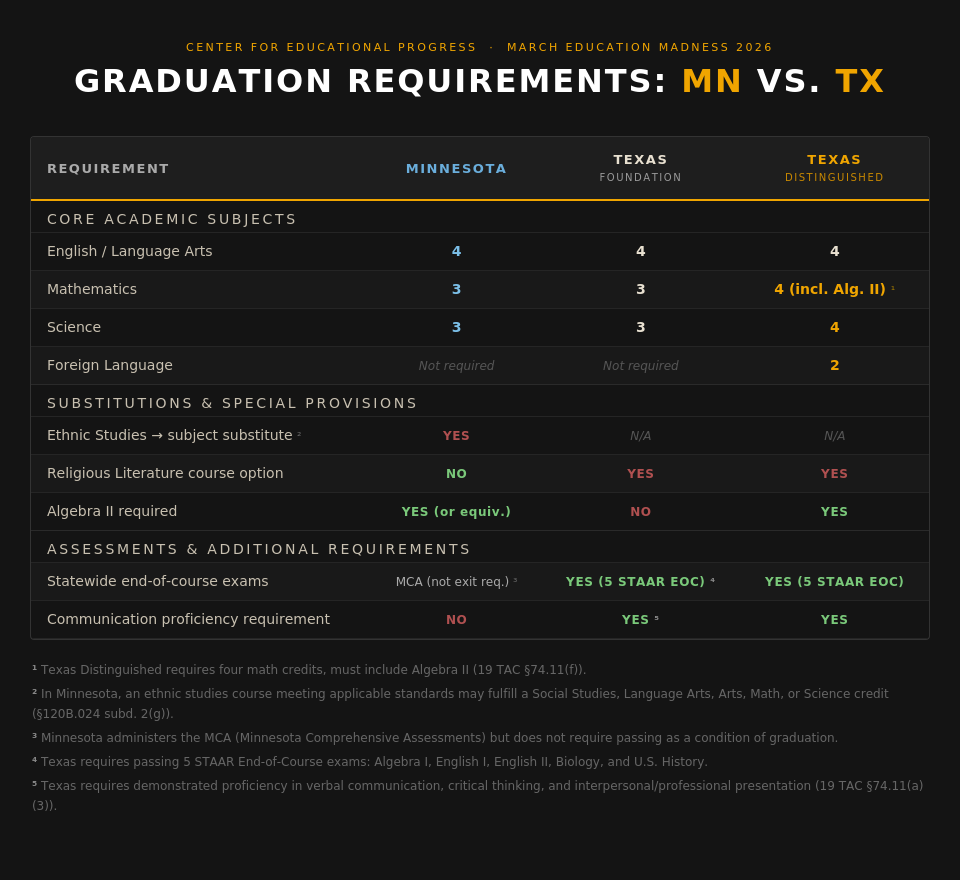
Across these criteria, then, Texas pulls ahead of Minnesota, primarily on the strength of its math instruction pipeline, its exam requirements, and the different diploma tracks.
Curricula and Culture Wars
Comparing Texas and Minnesota’s graduation requirements naturally raises another question: What are students actually learning in these required courses? In Minnesota, the answer is starting to get more complicated, because more controversial.
Before diving into the specifics, though, it will be useful (wise?) to be clear about what the real issue is here. The problem with Ethnic Studies mandates — in Minnesota, in California, and elsewhere — is not that schools are teaching more Black history, or Latino literature, or Native American culture. That’s fine. In principle it’s just and good.
The problem is that the ethnic studies curricula actually being implemented in American schools are bad. Not merely politically inconvenient, but academically lacking in fundamental ways. They’re built on shallow or uncontested ideological frameworks; they’re produced by a small network of consultant-activists; and, most importantly, they displace instructional time students need for foundational skills! California’s pioneering ethnic studies mandate — for a comparison from a much richer state — has effectively collapsed. It’s unfunded, hyper-litigated, and plagued by districts paying hundreds of thousands of dollars to consultants that frequently peddle reductionist and inflammatory narratives. (We’ll have much more to say about this slow-burn curricular grenade in a forthcoming piece.) The relevant point here, though, is that Minnesota looked at this track record and decided to go further, or worse, entirely failed to reflect on how similar efforts have gone.

In 2023, Minnesota’s education omnibus bill required ethnic studies courses at all grade levels — and allowed for an ethnic studies course to substitute for social studies, language arts, arts, math, or science credit, provided it “meets the applicable state academic standards.” A student in Minnesota can fulfill a math or science graduation requirement by taking an ethnic studies course.
You don’t have to be a conservative culture warrior to see the problem here. The math-and-science substitution isn’t about whether social studies electives should include more diverse perspectives. It’s about whether a course on systemic oppression and ethnic identity can do the work of an Algebra or Biology course. State Rep. Ron Kresha (R-Little Falls) has sponsored HF29 to repeal the substitution, arguing that mandates are “stealing time from reading, math and science.” The House Education Policy Committee approved it 7-6 in February 2025.
The statute’s defenders would note that the course must meet applicable state standards for whatever credit it replaces. But Minnesota’s ethnic studies standards are the issue — they frame American institutions as systems of oppression and position students as agents of resistance. A course satisfying those standards embeds an ideology that, long-term, destroys local trust and community buy-in to public schools. The standards themselves are the problem.
Texas, to be sure, has its own curricular controversies, most notably efforts to inject Christian sectarian doctrine (via the Ten Commandments) into classrooms. In addition to being unconstitutional, such efforts undermine the ways in which red-leaning states are getting things right. Ultimately, though, issues like displaying the Ten Commandments in classrooms — i.e., culture war issues — don’t really meaningfully distract from learning in the classroom. They affect roughly ~zero students’ capacity to do, e.g., long division. Minnesota’s ethnic studies substitution is different in kind: a statutory pathway to graduate without core math or science coursework, so long as the replacement checks the right ideological boxes.
The Learning Environment
The post-pandemic behavioral crisis forced every state to confront classroom order, but Minnesota and Texas have responded with fundamentally different philosophies about what a safe, focused learning environment requires. On phones, they’re converging. But on discipline, they’re diverging fast.
Devices & Distractions
As we discussed in the last Elite Eight matchup, school policies on phones and distracting devices seems to be a rare area of genuine bipartisan agreement in ed policy, something in short supply post-Covid. Both Texas and Minnesota recognize that phones are a problem for learning, mental health, and classroom focus, and we see both states moving in the right direction.
Texas has a bit of a head start, though, because last year Governor Abbott signed HB 1481 into law, requiring all school systems — traditional public districts, charters, and school boards — to adopt written policies prohibiting students from using “personal communication devices” during the school day. The bill also included money to help schools implement the ban, covering purchases of phone lockers, pouches, and other implementation costs.
The Texas bill gets correct a lot of the details of what can easily be a tricky or contentious kind of policy, as well. The ban covers the entire school day, and applies to free periods or free time between classes, too. All different sorts of devices fall under the “personal communication device” definition — so playing rules-lawyer on the ban will be tough — and it specifies straightforwardly that refusing to turn over a device counts as a student conduct violation, which in Texas gives teachers and administrators the flexibility they need to ensure distraction-free classrooms.
Minnesota is just a step or two behind Texas here. A 2024 law required every district to adopt some kind of policy governing phone use, but it didn’t specify what exactly the policy had to be. Many districts have since adopted strong policies about devices and phones (Stillwater and Saint Paul, to name two), but the statewide mandate from 2024 lacked teeth. Thankfully, the Minnesota legislature is now trying to strengthen that bill. HF 2516 is pending legislation that would require bell-to-bell bans for K–8 schools, and classroom bans for high school students. Hopefully the bill will be passed into legislation this year, if so adding another state to the list of those with strong, anti-distraction, statewide school policy.
Discipline
Texas and Minnesota are taking radically different approaches, though, when it comes to the question of discipline, safety, and student behavior. Texas has largely reversed course on experimenting with restorative justice (“RJ”) frameworks; Minnesota, on the other hand, is expanding their presence in its schools.
2023 was a watershed year for school discipline policy in Minnesota, as that year’s education omnibus bill embedded K–3 suspension bans, mandatory non-exclusion practices, and RJ practices into law, and thus into districts and schools across the state. Part of the law defines the kinds of practices schools must exhaust before choosing to dismiss/expel a student, like “PBIS,” SEL and mental health services, counseling, and academic interventions. Minnesota also apportioned several million dollars for RJ training, and requires each school to designate a staff member to ensure that such policies are “fairly and fully implemented.”
Last year there was an effort by some Minnesota lawmakers to roll back elements of the 2023 law; these bills appear to be stalling, however, and so the 2023 law remains on the books.
Texas, meanwhile, underwent its own period of progressive discipline experimentation — and then semi-promptly reversed course. Thus, it wasn’t exactly always red-state vs. blue-state on this issue. In 2017 and 2019, under Republican governance, Texas limited how and when schools could suspend young students, and many districts adopted restorative practices. But since the pandemic, there’s been quite a concerted backlash.
The legislature’s answer was HB 6, the “Teacher Bill of Rights,” which passed the House 124–20 in 2025 and was signed into law by Governor Abbott. Teachers in Texas can now remove a student from class after a single incident of disruptive, unruly, or abusive behavior, whereas previously the behavior first had to be documented multiple times. A removed student also cannot return to the classroom without the teacher’s written consent and a formal return-to-class plan. Reversing reforms from the last decade, Texas now allows students below grade 3 to be placed in out-of-school suspension if the behavioral issues are serious or chronic enough. Thankfully, HB 6 also created a Virtual Expulsion Program for students who’ve been expelled but cannot access a juvenile justice schooling alternative.
A Quick Note on Corporal Punishment in Texas
It doesn’t seem necessary, it’s clearly ripe for abuse (at least compared to alternative practices), and research suggests it doesn’t work. Texas should stop this practice, and props to Minnesota for getting this one right.
Minnesota and Texas are thus synecdoches for today’s dominant dueling meta-theories on school discipline and classroom order. Where Minnesota continues to build a system based on the idea that exclusionary discipline itself is the core problem, Texas understands that failing to remove disruptive students produces the most acute learning and lifelong harms for their peers, teachers, and school cultures trying to function. In our opinion, the evidence substantially favors the Texas approach, at least as a default.
Though the phone policy gap is narrow and closing, Texas wins on the core discipline question, i.e., whether teachers and administrators have the authority and tools to maintain orderly classrooms. Minnesota has chosen the progressive discipline orthodoxy; Texas has aggressively reversed course toward teacher empowerment and common sense. The corporal punishment thing doesn’t really look good for Texas. But it doesn’t change the overall assessment: Texas offers a learning environment where teachers can teach and students can learn without being held hostage by a discipline framework designed around the needs of the disruptive few.
Winner: Texas
Texas wins this matchup on policy substance, despite the prevalence of culture-war-first ed commentary. Stronger math teacher preparation, five mandatory end-of-course exams, a Distinguished diploma track, an enforced phone-free school law, and a discipline framework that empowers teachers stand out in this policy sphere.

