


Attacks on Excellence is a series from Education Progress featuring critical coverage of the education policies and research paradigms that are holding students back.
Give Part 1 and Part 2 of The Evidence Crisis in Math Reform sub-series a read if you missed them!
The latest “math reform finally works!” story comes from The Hechinger Report, featuring a Brockton Public Schools math curriculum coordinator celebrating supposed middle school gains using inquiry-first instructional methods.
A closer examination of the data, however, reveals a much different picture: the bottom has fallen out for the least advantaged students.
When ‘Productive Struggle’ Meets Real Struggle: Brockton’s Post-2021 Reality
Brockton serves over 15,000 students: 72% low-income, 34% multilingual learners, 53% with a first language other than English, and a recent influx of 1,500 migrant students, some of whom hadn’t attended school regularly since second grade. These are precisely the students who most need strong, evidence-based instruction, especially after COVID-era learning loss.
Instead, the district implemented a new curriculum in 2021 built around Carnegie Learning and problem-based learning (PBL). In lieu of clear teacher-led instruction, students are thrown into open-ended, “real-world” problems and expected to discover concepts through group exploration and “productive struggle.”
The Hechinger Op-Ed highlights Brockton’s MCAS (the MA statewide testing program) proficiency gains from 2021 to 2025: sixth grade proficiency rose from 11% to 21%, seventh grade from 13% to 16%, and eighth grade from 13% to 21%. The Op-Ed presents these numbers as proof that inquiry-first instruction works.
Yet 2021 was the height of COVID learning loss. MCAS scores collapsed statewide that year, and Brockton middle schools did not have in-person learning from March 2020 until March 2021. Massachusetts also announced that MCAS scores would not be used for accountability in 2021, reducing typical pressure on schools to maximize performance.
Using 2021 as the baseline is therefore highly misleading. When compared to 2019, the last fully pre-pandemic year, the narrative changes substantially. While the district’s highest performers show no improvement, the lower-performing students’ achievement has collapsed.
Trends for the most disadvantaged student groups are even worse between 2019 and 2025:
Cognitive Science and Federal Guidance Say Explicit Instruction First For Struggling Students, Not “Productive Struggle”
The U.S. Department of Education’s What Works Clearinghouse 2021 math practice guide for struggling elementary school students is unambiguous, based on its highest evidence basis rating: students who are behind benefit from explicit, systematic instruction with clear teacher modeling, guided practice, immediate feedback, and cumulative review. In other words, the exact opposite of Brockton’s instructional approach.
The 2008 National Mathematics Advisory Panel — a blue-ribbon group convened by the U.S. Department of Education that reviewed the highest-quality available research — reached parallel conclusions for students across the elementary and middle grades.* The Panel found that explicit instruction consistently improved outcomes for students with mathematical difficulties, particularly in computation and word problems. It recommended that struggling students receive regular, structured, explicit mathematics instruction with clear demonstrations, guided practice, opportunities to verbalize reasoning, and immediate corrective feedback.
This aligns with cognitive load theory. Novices have limited working memory. When students are thrown into minimally guided, open-ended tasks before they possess foundational knowledge in that subject area, working memory becomes overloaded. The result is often confusion and frustration rather than learning.
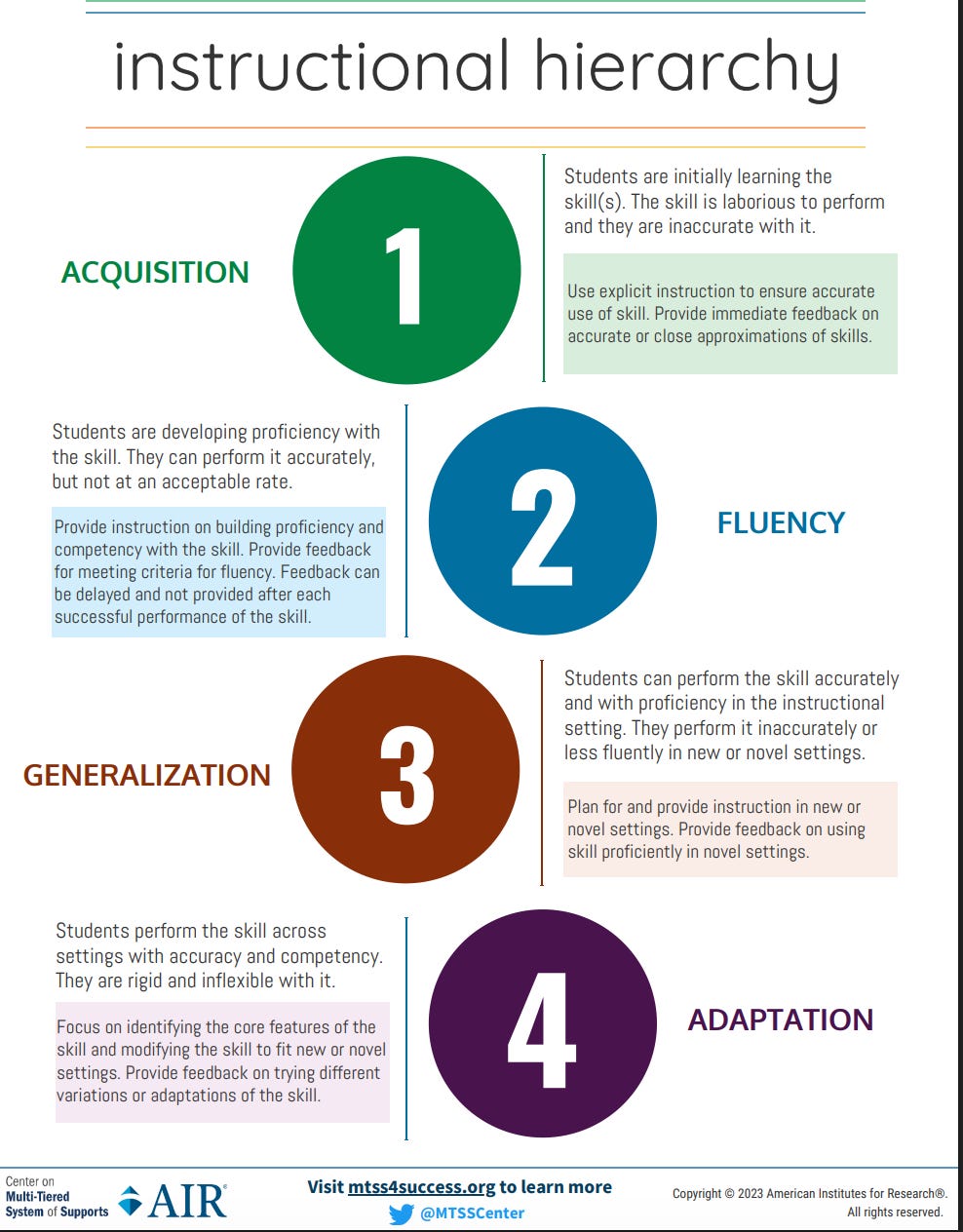
Inquiry-first advocates often dismiss critics by caricaturing explicit instruction as “sage on the stage” lecturing or mindless memorization, like in the Op-Ed. In fact, effective explicit instruction involves active teacher guidance, checking for understanding, deliberate practice, and gradual release of responsibility. It helps students build the schemas and background knowledge before moving to inquiry (i.e., inquiry as the final step, not the first one). It supports conceptual understanding, student thinking, and meaningful problem-solving.
This evidence-based learning process is demonstrated as follows:
“Productive Struggle” and Building Thinking Classrooms: Weak Evidence, Recycled Hype
Brockton’s story (and the broader inquiry-first movement) on math leans hard into the opposite: inquiry-first “productive struggle” (a rebranded PBL approach that, as Holly Korbey reported, a growing number of districts and teachers are jettisoning because of its lack of evidence), Peter Liljedahl’s rebranded PBL Building Thinking Classrooms (BTC), and other discovery methods.
PBL is not new — it is almost 60 years old, based on the century-old progressive education philosophy rooted in John Dewey’s “learning by doing.” The National Council of Teachers of Mathematics’s (NCTM) 1989 Standards elevated inquiry-first problem solving as a central theme in K-12 math classrooms — ideas the broader education world has promoted enthusiastically for decades since.
Supporters argue these approaches increase engagement, perseverance, and collaboration. But the evidence base is far weaker than advocates often suggest.
Even proponents acknowledge that BTC’s main research only measures engagement — student participation, “thinking” (which BTC essentially defines as discovery learning), time spent talking, and activity at whiteboards — and Liljedahl conducted such studies. But engagement is not the same as learning. Educational psychologist Paul Kirschner has often noted that students can appear engaged and busy without actually learning much.
Carnegie Learning: Marketing over Evidence
At the heart of Brockton’s “unified math strategy” is Carnegie Learning’s middle-school program. Carnegie heavily markets the program’s AI-driven personalization and collaborative problem-solving as proven solutions. However, the evidence is far less convincing than the marketing suggests.
The 2016 What Works Clearinghouse review examined numerous studies on Carnegie Learning and rejected most for poor research design, including several conducted by Carnegie itself. Independent large-scale studies have shown mixed or limited effects, with no rigorous evidence specific to middle-school settings. If the company is truly confident in its approach, why were its own studies too flawed to meet basic research standards?
Defenders often argue that these studies are outdated because Carnegie revised the curriculum in 2022. Yet Carnegie’s own 2023 “Evidence for ESSA” materials rely heavily on studies from 2018 or earlier, with no major new rigorous studies supporting the revised curriculum. Carnegie’s own internal reports are positive, of course, but this is marketing, not rigorous evidence.
The Hechinger Op-Ed even credits an interactive video streaming program for filling gaps, alleviating anxiety, and serving as a “lifeline” amid teacher shortages, while boasting a 440% increase in one school’s sixth-grade MCAS passing rates. But citing percentage increases at one school from an extremely low pandemic-era baseline masks significant declines across the district.
Brockton middle school math teacher Mike Sullivan told me:
“If the people downtown had put half as much energy into improving student learning as they did into gaslighting teachers about how great Carnegie was supposed to be, our students would probably be much better off right now.”
“If the people downtown had put half as much energy into improving student learning as they did into gaslighting teachers about how great Carnegie was supposed to be, our students would probably be much better off right now.”
Reading Lessons for Math: Why Evidence Keeps Getting Ignored
The parallels with reading instruction are striking. For decades, balanced literacy and whole-language approaches emphasized discovery-oriented reading instruction while minimizing explicit phonics instruction. Those methods failed many struggling readers, especially disadvantaged students. In the past few years, the Science of Reading movement reversed course by emphasizing systematic, explicit instruction grounded in cognitive science, and dramatically improved outcomes.
But such guidance was not new. In 2000, the U.S. Department of Education’s National Reading Panel reviewed the research and recommended systematic phonics instruction. Yet the broader education industry — publishers, teacher preparation programs, and many curriculum leaders — largely ignored or downplayed these findings. Instead of shifting practices, whole-language philosophy was simply rebranded as “balanced literacy,” with phonics treated as optional or incidental rather than systematic and explicit.
The 2008 National Math Advisory Panel report met a similar fate. Former panel member and Brookings Institute scholar Tom Loveless observed that its findings “just collected dust on bookshelves,” particularly among advocacy groups like NCTM. Nationally, NAEP 4th- and 8th-grade math scores have been essentially flat for the past 20+ years, showing little sustained progress from widespread inquiry-oriented approaches.
A Failed Experiment Repackaged as Success: The Hechinger Report Should Retract This Op-Ed
This recurring disregard for evidence is precisely why the Op-Ed in The Hechinger Report is so damaging. By anchoring to a 2021 pandemic low, the Op-Ed spins a modest rebound among higher performers as proof that inquiry-first methods succeed with underserved students. Remove the distorted baseline, and the data reveal widening gaps and collapse among those who need help most.
Education journalism owes high-needs districts more: honest scrutiny, rigorous evidence, and methods grounded in how students actually learn — not repackaged experiments sold as breakthroughs. This misleading piece fails exactly the students it claims to help. The Hechinger Report should retract it.
*The story has been updated to clarify the description of the 2008 National Mathematics Advisory Panel report’s recommendation on explicit instruction.

I appreciated your cogent analysis, but it seems to conflate three dimensions at once:
* direct instruction vs Inquiry
* disadvantaged vs “normal”
* early stage vs late-stage inquiry.
Could you please entangle them for us?
Thank you :-)