

Attacks on Excellence is a series from Education Progress featuring critical coverage of the education policies and research paradigms that are holding students back.
LATER TODAY, the SFUSD Board of Education will vote on a new math placement policy for the district’s middle schools. In 2014, Algebra 1 courses were removed from middle schools as part of a “detracking” effort by the district to address racial gaps in advanced math placement. This idea, of course, was a terrible one. Despite some early calls from proponents about the “promise” of detracking, like this op-ed from Jo Boaler, the end results were predictably terrible. Achievement gaps likely increased, advanced course enrollment fell, and trust in the public schools declined.
It took nearly ten years and sustained focus from parents and politicians to get the Board to vote in 2024 to restore middle school algebra to all middle schools by the 2026-27 school year. And voters demanded the restoration again a month later, overwhelmingly passing Prop G (~80% in favor), a ballot measure calling for the return of middle school algebra classes.
What the district is actually proposing to deliver — after all of that — is a system where only 2 of 21 schools have a real pathway to standalone algebra. At the other 19, even students who qualify will need a counselor meeting and signed parental consent to opt out of their normal grade-level math course.
This result is frustrating, but also hardly surprising: What do you think eliminating Algebra 1 in middle school meant? No math anxiety? No unequal enrollment numbers?
If only!
Confusion and reform (2014)
The debate over whether Algebra 1 should be offered in SFUSD middle schools was distorted from the start, because the stated goals of the detracking effort were either confusing, misleading, or largely pretextual.
Details from the actual Board meeting for the original vote are illustrative and familiar. The reformers were clearly motivated to reduce or eliminate racial enrollment and achievement gaps in the district, but this justification is obviously not enough for the parents, educators, and civic groups who rightly reject lowering standards and limiting academic opportunities as means for achieving those goals. So the reformers defended taking away middle school algebra by claiming that the new plan would teach fewer topics more deeply, thus making it more “focused” and “coherent.” Advanced students will not be served worse, just differently, because the emphasis on conceptual understanding and problem-solving in the new courses will provide stronger foundations for future, more difficult courses. (The same arguments are being levied against gifted and talented programs in New York City.)

Decades of bad scholarship on the harms of tracking students has given the veneer of empiricism to lots of shoddy arguments in favor of detracking, so I won’t say those were pretextual. What does seem pretextual, at least in hindsight, is the supposed need to detrack middle school math in the district in order to prepare students for new Common Core standards the state was adopting after No Child Left Behind was repealed. If offering middle school algebra was so unworkable in the new framework, why did so many nearby districts not follow SFUSD’s lead?
The long decade (2014–2023)
Nearby districts made the right call by not detracking middle school math. The decade after SFUSD did so proved the reformers wrong and the critics right: achievement gaps increased, advanced course placement went down, and student schedules got less coherent.
A Stanford study found that not only did detracking do nothing to address the racial math enrollment gap in SFUSD, but it also led to a ~15% decline in AP math course enrollment overall. The term for this isn’t “equity,” but “leveling down.”

Families with resources found workarounds to their kids’ now-degraded public math education. By the Class of 2021, nearly a quarter of students had to double-up on classes and summer coursework to get around district restrictions. Private tutoring and outside coursework (like Khan Academy) also boomed in popularity over this decade, though the exact numbers there are harder to quantify.
Enrollment also cratered over this period, going from roughly 58,000 students in 2014-15 to about 49,500 by 2023-24. Attributing that to detracking middle school math or any other single controversial SFUSD policy would be hasty, though, given that falling enrollment is a national trend, highly accelerated by the Covid closures and rising classroom disorder. Still, detracking SFUSD middle schools almost certainly contributed to this trend, making public middle schools that much less attractive to any parents with children who learn math faster than their peers.
The district’s early claims of success, meanwhile, were starting to fall apart under scrutiny. Jo Boaler and SFUSD had been advertising the seemingly positive results from detracking, such as fewer students repeating Algebra 1 and increasing enrollment in “advanced” math courses. As a result, the first draft of California’s new math framework even cited SFUSD as a model for the state.
When the parent group Families for San Francisco filed public records requests and looked into the actual data, though, the picture started to change. Tom Loveless has a great article going over the different ways SFUSD et al. contorted the data to try to find a good narrative to sell the public. In short, the drop in repeat rates was largely because the district dropped a required end-of-course exam to advance to Geometry (a classic “equitable grading” practice!); the “advanced math” enrollment gains relied on counting a compressed Algebra 2/Precalc course that the University of California — the state’s most prestigious public higher education system — refused to classify as advanced. Excluding this course erased any enrollment gains the district had been touting.
It’s no wonder, then, that in 2022 San Francisco voters recalled three SFUSD school board members in a landslide. The algebra debacle was just one of several grievances that fueled the recall, alongside unpopular efforts to rename schools and controversial admissions changes for Lowell High School, arguably the district’s most prestigious magnet program.
The Board relents and the voters speak up (Feb–March 2024)
Even after the recall, it took the new board another two years to actually vote on reinstating middle school algebra. The board voted 6-1 to do so on February 13, 2024. The plan was to introduce a two-year pilot program at roughly ten schools, testing three different models for offering middle school algebra, with a full rollout to all 21 schools by the 2026–27 school year.
After a decade of being forced to play algebra-keep-away with SFUSD, voters were understandably less trustful of the district’s will and ability to bring algebra back. The new plan from the board was yet another delay, and seemed to risk overcomplicating the matter by testing out three separate models in only a little under half of the district’s middle schools. Algebra access was still limited, and so voters responded by overwhelmingly passing Prop G, a non-binding ballot measure making it the official position of the government of San Francisco that SFUSD reintroduce algebra to its middle schools.
Where’s the algebra? (2024–25)
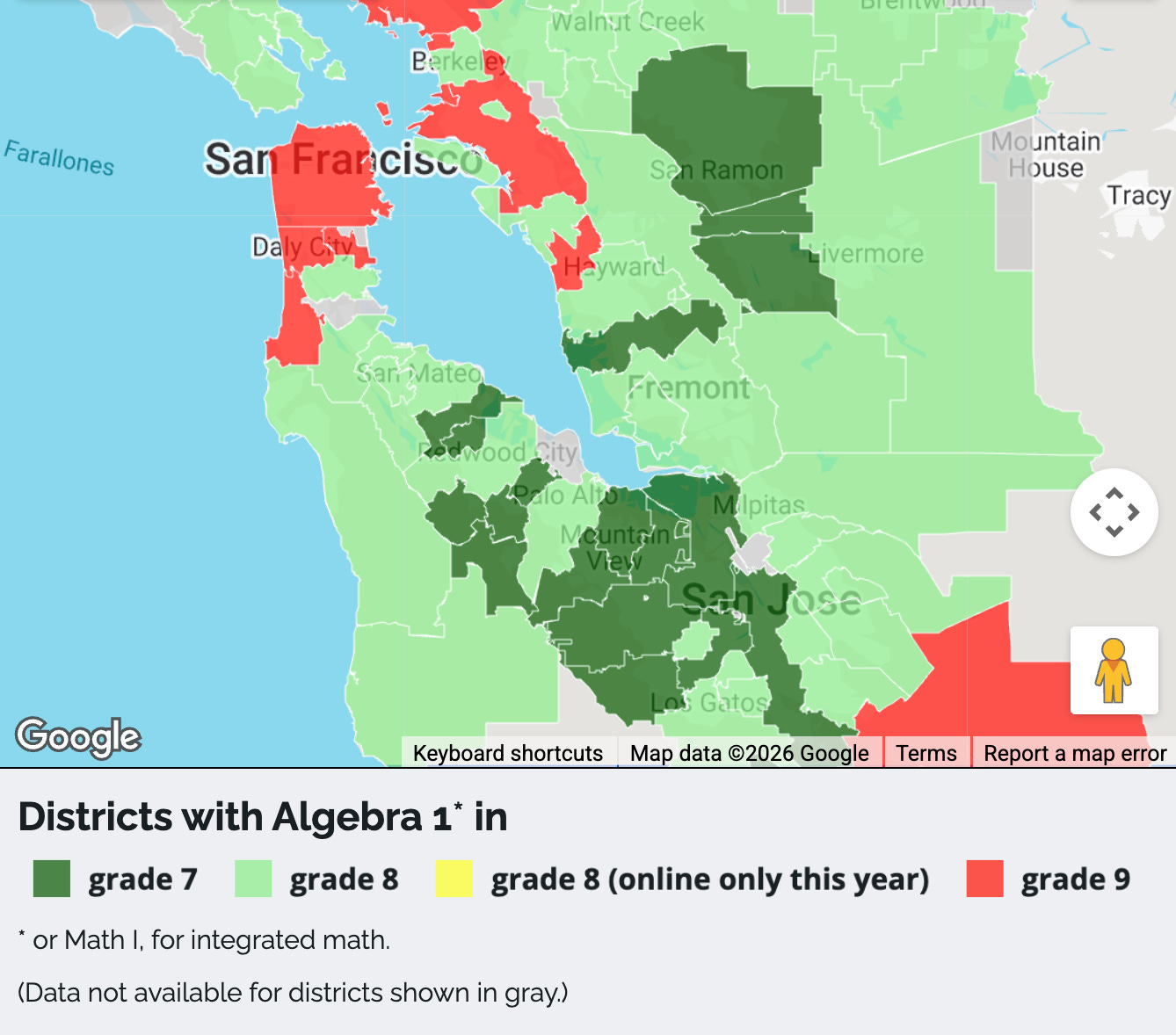
As of November 2025, roughly half of San Francisco’s middle and K–8 schools were still not offering on-site algebra. And as the San Francisco Standard reported, at places like Denman Middle School, opposition to middle school algebra can still come from ideologically motivated school officials and principals standing athwart the motivated students and dedicated teachers begging their admin to let them learn and teach algebra. The district’s spokesperson, per the Standard article, also refused to answer questions about whether on-site algebra will be available at all schools this coming year.
For parents and students at the non-pilot schools, the options remained a self-paced online course with no live instructor, or a compressed summer program. Algebra is offered in middle schools across the country, and yet for SFUSD this offering is already becoming some kind of lost technology that seems impossible to recreate. But it’s just basic course scheduling, at least until convoluted values and mismanaged reform programs get in the way.
Algebra slow-rollers (Today–???)
All of this brings us to today. Or a couple hours from now, rather, when the board will vote on whether to move forward with only mild modifications to the original 2024 plan. In the newest version it will be possible for some students to take Algebra 1 as a standalone course in 8th grade; i.e., they can take the course without having to also enroll in normal 8th grade math (“Math 8”), which would cost them one of their elective slots.
The catch? Only two middle schools in the district — out of 21 — will offer the Algebra 1 standalone course. There are also the strange additional procedural requirements that somehow manage to both (1) make it harder for prepared kids to take the course, and (2) make it possible for unprepared students to enroll as well. Students deemed “academically eligible” (according to their prior scores on state exams) can opt out of Math 8, but only after a counselor meeting and with written parental consent. Students deemed not eligible can take it as well, but cannot drop Math 8, and so will lose an elective. (What even…? Whatever.)
Only two schools — Hoover and Alice Fong Yu — will implement an accelerated math pathway that will allow students to avoid “SFUSD’s Algebra Fork” of a policy, which seems tailor-made to make taking algebra in middle school as convoluted as possible. Moreover, Hoover and Alice Fong Yu’s model is the model used by nearly every nearby district, so again, this problem was both conjured by (and remains relatively unique to) SFUSD policy and personnel.
According to Teresa Isabel Shipp, SFUSD’s Associate Superintendent of Educational Services, the goal of this new scheduling policy is “to ensure that every middle grade student has sustained time to read deeply, write thoughtfully, solve complex problems, ask questions and receive meaningful feedback from their teachers.”
That is a fine goal. It also has nothing to do with why 8th graders still cannot take a normal algebra class at 19 out of 21 district middle schools. Reintroducing algebra in such a bizarre, inefficient, and inequitable way is bound to cause more headaches and resentment. More important, though, is how bad implementations of good public policy can undermine years of slow, agonizing progress, thwarting political majorities and further distancing elected officials from the opinions and values of their constituents.
Let’s see how today’s vote goes.
UPDATE [03.25.26]
My take on details from the recent San Francisco Chronicle article:
The board voted 4-3 last night to approve the plan. Superintendent Su called it a “major milestone” that “continues to be rooted in equity,” which is a remarkable thing to say when you are the institution responsible for creating the problem you now must ever-so-carefully manage. SFUSD eliminated middle school algebra, watched the predictable consequences unfold for a decade, and is now treating the complexity of undoing its own mistakes as evidence of its own seriousness and moral virtue.
PTSA President Sara Meskin probably put it best: The plan is “really convoluted,” and “access to algebra in middle school should not be only for kids whose parents are able to navigate the system.” She’s right. And she’s also describing the system the district just built, twelve years after messing up and leaving multitudes of cohorts behind.


Students have widely varying abilities and aptitudes for various academic (and other) activities. This results in cumulative differences in mastery over time. Educators largely deliberately ignore the consequences of this.
As I remember it, when Boston started public schooling over a century ago they used a crude form of mastery progression, with students being held back until they demonstrated mastery. After being held back 2 or 3 times, most students dropped out - hence age grouping and social promotion.
But even so, the difference in mastery makes common assignment to grade classrooms problematic even in elementary school. By the end of 5th grade (the last grade in elementary school in the local school districts where I live) some students are fully ready for algebra, others are still struggling with arithmetic; some are reading at the 12th grade level while others have very rudimentary reading levels. A shared classroom with such a span is inappropriate for both the advanced and lagging students.
Classes should not be gated on grade level - but on advancement and readiness - with support for some students taking classes at significantly higher grade levels. Students can be fully ready for university STEM classwork by age 15 - but this means that the schools need to support mastery level placement as soon as the students start Middle/Junior high school.
My son, who was not at all academically inclined, still survived STEM calculus when he took it via Running Start/ College in High School when he would have been a high school junior. His older sister, who was academically inclined, took it when she was in 10th grade. There were a lot of high school students taking advantage of the Running Start program - although many were slackers.
Interestingly, I attended a public school board meeting many years ago when they were discussing the sizing of a high school that was being replaced. The school board knew that a substantial fraction of the students would do Running Start - and reduced the school size because of the correspondingly reduced student body. So it is planned for - and the regular curriculum here would support students being ready for Calculus in 11th grade. The students just had to select into the more advanced curriculum and survive it. Doing Calculus earlier then 11th grade required extra work on the part of the parents and their students.
What is on offer for the elective? Along with a cohort of about 5 other families, we fought to have our kids take pre-algebra in 6th grade. This is a tiny district and our families are about 15% of the kids in their year. The school relented and allowed our kids to advance (all scored above 90% on the state test), but only if they simultaneously took Math 6 with their age group. But they didn't lose an elective. They lost a study hall. Even with that, they still take a study hall. The alternative to doubling on math was two study halls! Our electives are only things like music and art. We have no real electives. I wonder what the SF district electives are like. If the kids are being asked to give up a study hall, that is one thing. If they are losing out on taking an actual real course, that is something else entirely.
I understand why everyone looks to SF. However, our shrinking rural schools are also a disaster. Everyone who can leave does. We are pulling out kids out. Originally, the plan had been to wait until after middle school, but we can't continue with the way things are now. The only kids left are the truly underserved who have no one to advocate for them. It is a crying shame.