


Samantha Lippert is a third-grade teacher and the author of an awesome Substack herself. We came across this piece and thought it was one of the clearest practitioner accounts we’ve read of what happens when classroom instruction is actually aligned with learning science — so we asked if we could share it with our readers. She said yes!
This past week I was standing at my classroom’s small-group table, surrounded by nine students leaning forward in their chairs, eyes fixed on me, waiting for the next lesson.
What struck me in that moment wasn’t just their attention, but it was what they were ready to learn.
Every student sitting around that table had already mastered the core math facts traditionally taught in third grade. Addition and subtraction facts were automatic. Multiplication facts to 81 and division from 81, skills many students don’t master until much later in the year, were already fluent. Now, they were moving on to more complex mathematical work together, eager for the next challenge.
They weren’t asking if the work would be hard.
They were asking what came next.
Before beginning instruction, I paused and said, “I want you all to know how proud I am of you. You’re working on math skills above third-grade level. I’ve never had a group of students who mastered their facts like this and were still so excited to keep doing harder and harder things.”
Their faces lit up with smiles, not because the work was easy, but because they knew they had earned their way there.
That moment captured something powerful: students experiencing success not by chance, but through instruction intentionally aligned with how learning actually works.
The Question That Changed My Thinking
In math education, we often say students need “more practice.” More worksheets. More repetition. More time.
But this year, my classroom data pushed me to ask a different question: what if the problem isn’t the amount of practice, but the design of it?
At the beginning of the year, Acadience Math data showed wide variability in my third-grade class, with 44% of my students performing below benchmark. What stood out wasn’t a lack of understanding. Students often knew what to do. The issue was how much mental energy basic computation required. Counting strategies lingered, simple calculations took time, and by the time students reached problem-solving, their cognitive resources were already depleted.
Learning science explains this clearly: when foundational skills aren’t automatic, working memory is consumed before reasoning can even begin. Instead of asking students to try harder, I needed to change the instruction itself.
The Instructional Shift
This year, my classroom implemented a program developed by Brian Poncy, called Facts on Fire, a structured math fluency system grounded in cognitive science. The daily routine took just about four minutes, but it was intentionally designed. Students practiced skills at their individual instructional level, advanced only after demonstrating mastery, and engaged in brief, timed retrieval practice with ongoing progress monitoring .
The goal was never speed.
The goal was automaticity — effortless recall that allows students to focus on thinking rather than calculating.
Those four minutes became a protected part of Tier 1 instruction within my classroom. Differentiation was embedded into the structure itself, allowing students to access the same core instruction while progressing along individualized learning paths for their math facts.
Why This Works
Facts on Fire reflects how the brain actually learns. Students retrieve information from memory rather than reviewing it passively, strengthening neural pathways and making learning more durable. Since practice is brief and consistent, it is spaced rather than massed, leading to stronger retention and less forgetting.
Students work at the edge of their competence — challenged but not overwhelmed — which maximizes growth without cognitive overload. As automaticity develops, cognitive load decreases, freeing students to focus on problem solving, reasoning, and conceptual understanding.
Fluency doesn’t replace thinking. Fluency supports thinking.
What The Data Showed
By mid-year, the classroom data has told a clear story. In September, most students had mastered only basic addition facts, subtraction mastery was limited, and no students demonstrated mastery of advanced computation. By February, nearly all students had mastered foundational facts, subtraction skills expanded significantly, and many students progressed into multi-digit computation. Growing numbers reached multiplication and division fluency, and some advanced into higher-level algorithms.
This growth occurred within a heterogeneous classroom that included four students receiving special education services for Specific Learning Disabilities (SLD) in mathematics. These students participated fully in the same structured fluency routines as their peers as part of Tier 1 instruction, with individualized placement and mastery-based progression embedded into the system itself.
Automaticity develops through efficient retrieval. When practice is untimed, students can rely on compensatory strategies that allow completion without strengthening memory. Timed retrieval, when used intentionally, in short intervals and paired with mastery-based advancement, supports the neurological processes required for fluent recall.
For this reason, students with IEPs participated in the same timed instructional practice as their peers, while extended time remained available for assessments and evaluative tasks. This approach aligns with both learning science and the intent of accommodations: supporting access to learning rather than removing essential components of instruction.
Acadience Math benchmark data reflected the impact of this inclusive, science-aligned approach. From the beginning of the year to the middle of the year, students averaged approximately 63 points of growth, with individual gains ranging from modest increases to growth exceeding 100 points. Nearly every student demonstrated positive movement, and several transitioned from well-below benchmark into approaching or benchmark ranges. The percent of students below benchmark on Acadience went from 44% in September, to only 19% in February.
Notably, students who began the year with the lowest scores, including students receiving special education services, often demonstrated the largest gains. Systematic fluency instruction functioned as an equity lever, reducing opportunity gaps rather than reinforcing them.
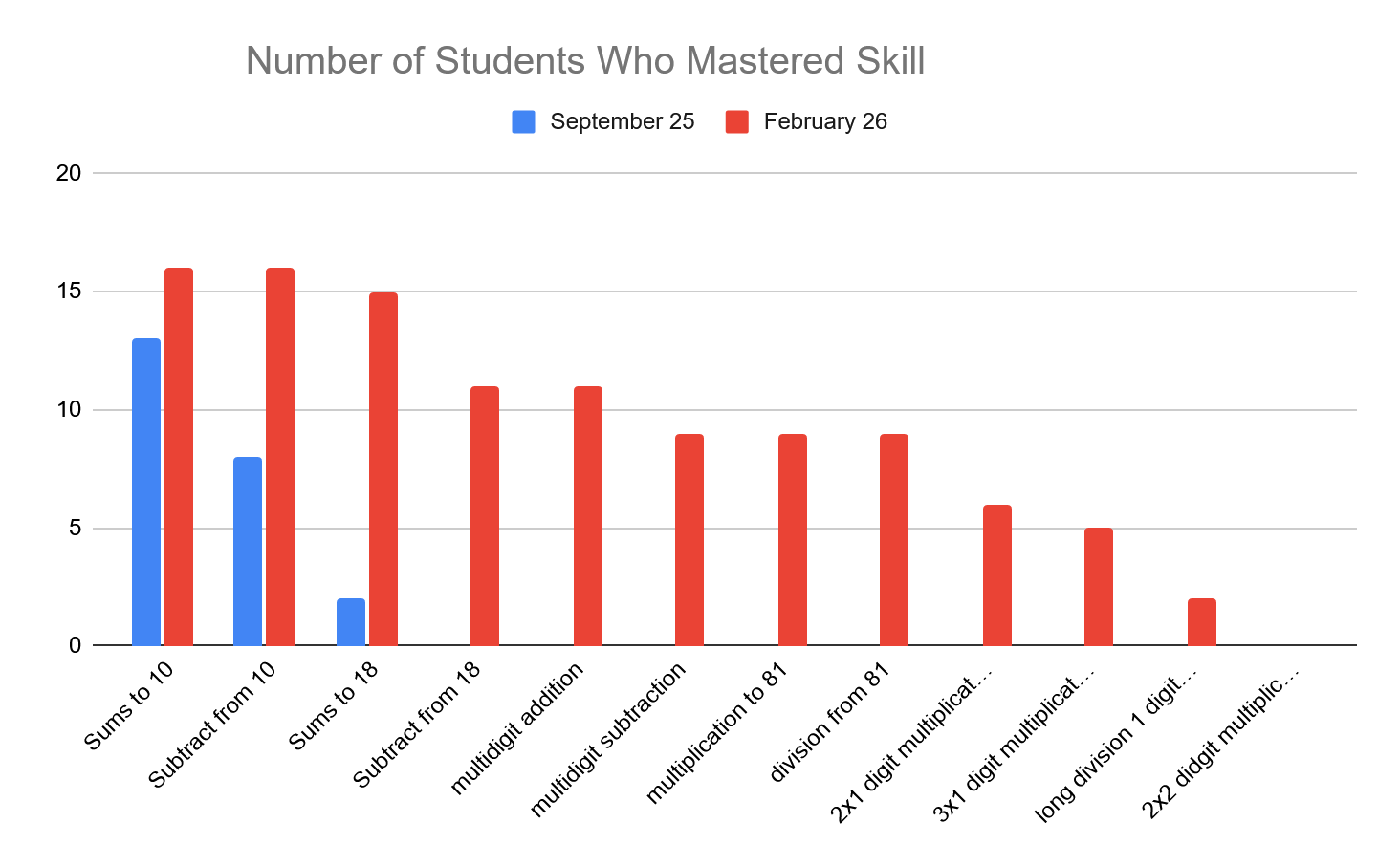
What The Growth Revealed
The most important change wasn’t higher scores.
It was growth — academic and internal.
Students weren’t just getting faster at the same skills. They were advancing into increasingly complex mathematics. As automaticity increased, cognitive effort decreased, allowing students to take on harder problems with greater confidence and stamina. This progression mirrors exactly what learning science predicts when instruction includes retrieval practice, spaced repetition, mastery-based advancement, and immediate feedback.
Math fact fluency is often misunderstood as memorization. In reality, it functions as a cognitive support system. When foundational knowledge becomes automatic, persistence increases, frustration decreases, reasoning improves, and confidence grows. Automaticity doesn’t replace thinking, it creates the space for understanding.
That is why the growth didn’t stop at performance.
The biggest surprise wasn’t academic, it was emotional and motivational. As progress became visible and predictable, effort reliably led to success. Math stopped feeling like guessing and started feeling learnable.
That shift was most evident in the questions students began to ask. Instead of asking whether they were finished or how much time was left, students started asking, “What will I move onto next?” — often before they had fully mastered their current skill. They weren’t rushing the work. They were anticipating what came after it.
Those questions revealed something deeper. Students no longer viewed learning as a pass-or-fail moment. They understood it as a progression. Mastery wasn’t the finish line — it was a gateway.
That is what I later saw at the small-group table. The students leaning forward, eager for the next challenge, weren’t unusually motivated children or a “high” group by chance. They were students who had experienced success so consistently that they trusted the process. In learning-science terms, their self-efficacy had increased, and the expectation that effort leads to growth had become internalized.
They didn’t ask if they would grow.
They asked what came next.
And when students come to expect growth rather than fear failure, the classroom itself begins to change.
Coming Back to That Table
Later that day, I found myself thinking again about the nine students gathered around the small-group table — the same students working beyond third-grade expectations, leaning forward, asking for harder problems, eager for what came next.
That moment didn’t happen by accident.
It was the result of small, consistent instructional decisions grounded in learning science. Four intentional minutes a day. Clear goals. Immediate feedback. Practice designed to match how the brain actually learns.
Over time, those decisions changed more than skill level. They changed how students saw themselves. These students weren’t just faster with math facts. They had become learners who trusted the process of learning, who expected growth because they had experienced it again and again.
Standing there with them, the pattern was impossible to ignore. When instruction is aligned with learning science, success stops feeling like a surprise.
It becomes predictable.
I was standing at our small-group table, surrounded by nine students leaning forward in their chairs, eyes fixed on what they were ready to learn next.
Final Reflection
Educational improvement doesn’t always require sweeping reforms or longer lessons. Sometimes transformation begins with small routines grounded in strong evidence.
In our classroom, four intentional minutes a day changed how students experienced mathematics and, more importantly, how they experienced themselves as learners.

I believe this is a true story, and a wonderful one. But the writing feels like AI.
I'd rather a sloppier story that let's me see the teacher.
ai;dr