


The first in a new set of posts on AI in schools and the history and future of educational technology.1
Theories of Progress is a series from Education Progress building the intellectual framework for durable education reform: why the system resists improvement, what excellence actually requires, and what history tells us about how to build it.
1. The Scholastic Thermidor
I entered middle school just after the release of the first iPhone, and left a small handful of Bitcoin on my high school-issued laptop when I returned it to the technology office after graduating, in 2014. For my cohort — the tail-end of the millennial generation — the revolution in educational technology proved an exciting opportunity, especially for those of us that liked coding and playing video games.
But now looking back, it feels more and more like we were actually on the last chopper out of Saigon. Algorithmic content and short-form videos had yet to take over, and by childhood’s end at least half of our learning had still been through real books; not on screens, but in chapters, on paper worksheets, with pens and pencils. How did ed-tech get so pervasive, and go so wrong? And why did all of society seem to move in lockstep behind it?
I’ve started calling the first ed-tech revolution the Scholastic Thermidor because, besides a deluge of laptops and would-be subscription software purchases, the true revolution occurred elsewhere — in the back offices, in the slow birth of yet another “industry.” Thermidor captures the sense of a revolution unraveling, of a different interest or faction taking over from an earlier, more radical attempt that was running out of steam. It emerged from the Thermidorian Reaction, when Revolutionary France in 1794 started to realize it had lost its marbles during Robespierre’s Reign of Terror. Over a century later, Leon Trotsky revived the term in a somewhat propagandistic attempt to delegitimize Stalin and the October Revolution he had betrayed.2
Throughout our own revolutionary period, we have seen lots of new technology introduced into schools, but vanishingly little that actually innovates on the educational side. The “ed” in “ed-tech” was thus mostly speculative — Can interactive laptop software work in a classroom setting, with 20+ kids? What if it replaces pen and paper, or whole books? What if software companies were about to discover a new monetization model that came for the schools like a ravenous pack of hyenas? — but for decades we proceeded as though someone, somewhere, had shown that the cultural institution of pedagogy and the bio-mechanical activity of childhood learning can be moved en masse onto devices, into screens, through the Looking Glasses.
The genuine technological breakthrough for education, however, was the one manifest in No Child Left Behind3 and regular student assessments, better data about group proficiencies and performances, and a greater ability to monitor the results of a discipline (pedagogy) and a profession (teaching) that, for now, just had to have enough computers for students to take state tests a couple of times a year. Though flawed, the accountability revolution at least posed the right kind of question: Are students learning?
The Scholastic Thermidor changed the question. Are students using the new technology? One-to-one devices, flipped classrooms, 21st-century skills programs, and “personalized” instructional software were still in their infancy, but the future of the first revolution was already theirs.
2. No Child Left Behind
The first ed-tech revolution could not have come at a better time. I remember the transition. For me, from 1st through 4th grade (until 2006, roughly), computer classes were taught in the computer lab, on a couple dozen of those really cool-looking early iMacs:
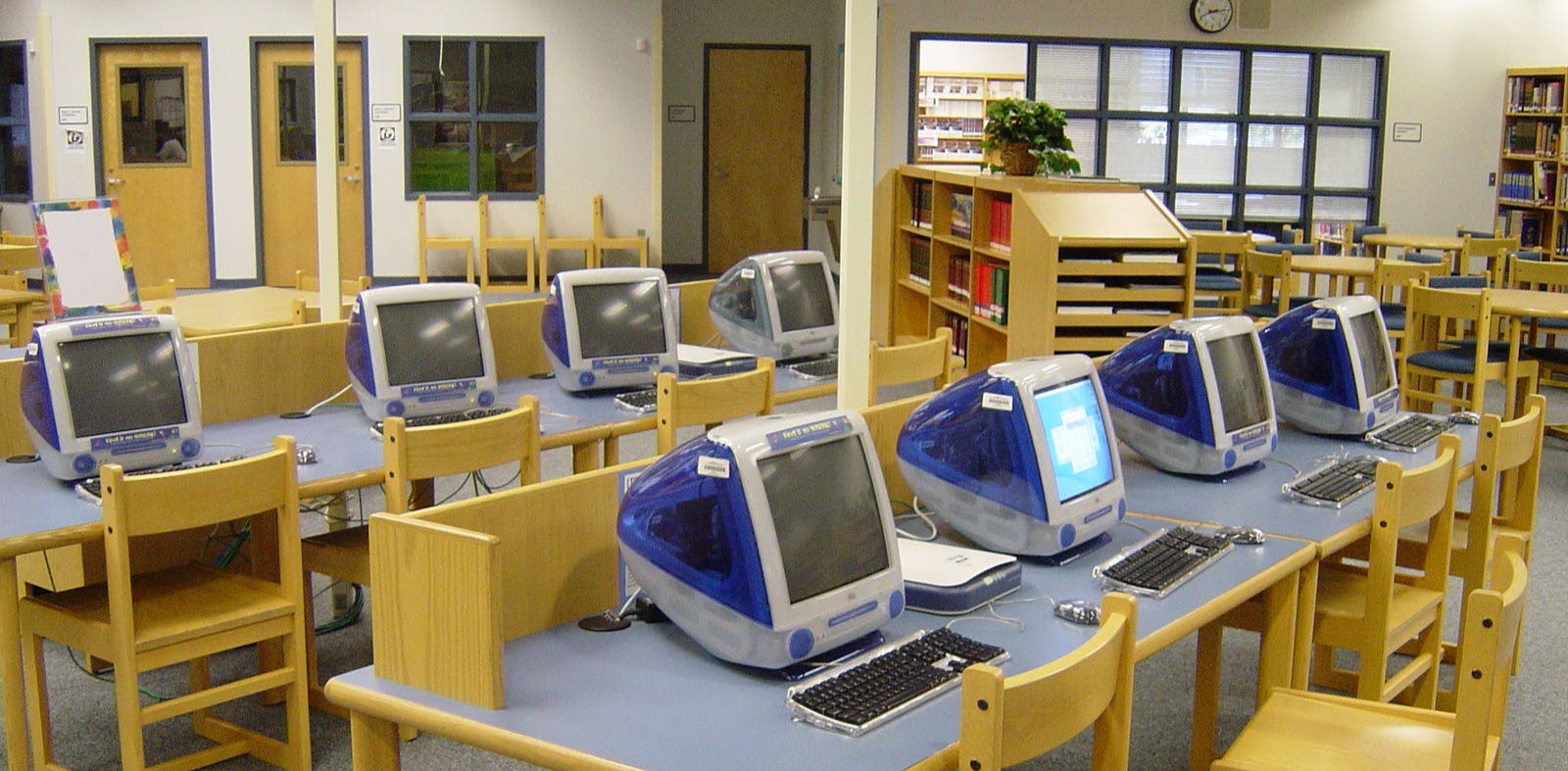
The classes were mostly typing classes, from what I can remember. By 5th grade (~2006–2007), though, the computer lab had gone mobile, replaced by the “laptop carts,” which became regular features of every classroom that could find a way to use them. Maybe my experience was the exception, but laptops seemed to augment the classes that incorporated them, more or less. The two negatives that stand out to me now are:
The capacity for hijinks had radically increased, and we quickly became far more “technologically nimble” than most adults by the end of 7th grade.
Web browser games like RuneScape and Arcanists, and websites like MiniClip and AddictingGames, which decimated our sleep cycles. Worth it.

But besides these, early laptops were honestly pretty useful. It helped that we already had a solid amount of analog learning under our belts — to the point where we were writing a couple short paragraphs by hand, filling out basic research reports, making bibliographies and looking things up in encyclopedias. Laptops could then be introduced and, on the whole, make things a little bit better. Better presentations, more diverse research projects, more engaging classroom work via early apps, and all sorts of different little optimizations became possible.
The other side of this story, however, was all the awkward tech issues, bulky laptop carts or broken laptops, but also just the general sense that handwriting was old, laptops are new, and the future is computers so if they can use them, they should. New technologies and cultural habits were now jockeying for our time. Laptops also kept getting less and less expensive, and WiFi speeds faster and faster.
But seismic legal changes had set the Scholastic Thermidor in motion nearly a decade before my freshman year of high school even started.
In January 2002, George W. Bush signed the No Child Left Behind Act (NCLB) into law, kicking off the “accountability revolution” in American education. This was the legal expression of the real first ed-tech revolution. That is, the true ed-tech revolution was the accountability revolution, because digital testing and reporting architecture (a new “accountability tech stack” for schools) made truly national assessment, reporting, and accountability practices possible. The federal government could now set standards, take measurements, and create incentives4 because the vast majority of students could be expected to take tests a couple of times a year, and states could convert the results into actionable information. That revolution drove much of the good that came from the era. Put another way, accountability architecture is necessary for modern education reform efforts, but far from sufficient if weak curricula, bad theories of learning, and perverse incentives abound.
The true ed-tech revolution was just the accountability revolution, because now with digital testing and reporting architecture (a new “accountability tech stack” for schools), truly national assessment, reporting, and accountability practices were possible.
Unfortunately, the tech stack underlying the accountability revolution was not going to be contained. The task would have been difficult even in hindsight, because it never would have been easy to prevent all ~14,000 school districts from succumbing to unregulated market and social pressures to innovate, on top of a legal mandate for schools to have certain tech available. That is, after No Child Left Behind was passed, it simply became legally and institutionally unsustainable for schools to not have a tech stack. So grew the ed-tech consumer base.
Maybe the story could have been different in a timeline where laptops were somehow never invented, or where costs prohibited schools and students from ever moving beyond a shared computer lab, but that’s not how technology or innovation work. Ed-tech was not merely going to transform how we monitor schools or measure students — no, it was promising a beautiful revolution in pedagogy and learning, too; an entirely new era for what it meant to teach and what it meant to be a student. That was half right.
The cultural catalysts for the Scholastic Thermidor were many, and powerful. Collectively, they produced an atmosphere ripe for overlooking the crucial question of whether learning and teaching could be successfully digitized.
3. Fervors of Progress
The paper-reduction craze was one of the odder ones. Our civilization does not have the best track record with sensible recycling or paper reduction efforts — one of the biggest causes of government paperwork, for example, is the Paperwork Reduction Act. (“For every new agency policy, generate and print a report about how it minimizes environmental impact and paperwork.”) Regardless, the number of times using laptops was pitched to us as some collective do-good effort was too many to count. “Instead of cutting down a tree, do the worksheet and submit your answers and get your grades online.” Or maybe consider how this poor village across the world was polluted by a paper mill. I also remember being told that laptops could be used, somehow, to give children in Africa access to a wealth of educational opportunities. The biggest educational barrier in the developing world was of course its lack of Western Content, and not its unstable governments, dictatorships, or general insecurity.

Part of this was also an understandable “grass is greener” fallacy when it came to textbooks and physical learning materials in general. Beyond being made from trees, they also took up space, students damaged and destroyed them, they went out of date, and there was even a whole panic about the dangers of increasingly heavy backpacks. The brute costs of maintaining an analog inventory of teaching materials pervaded school life; teachers had to spend time in class managing students who had lost their homework or brought the wrong textbook, and the need to have certain learning materials all in one place put great constraints on school scheduling and class(room) availability.
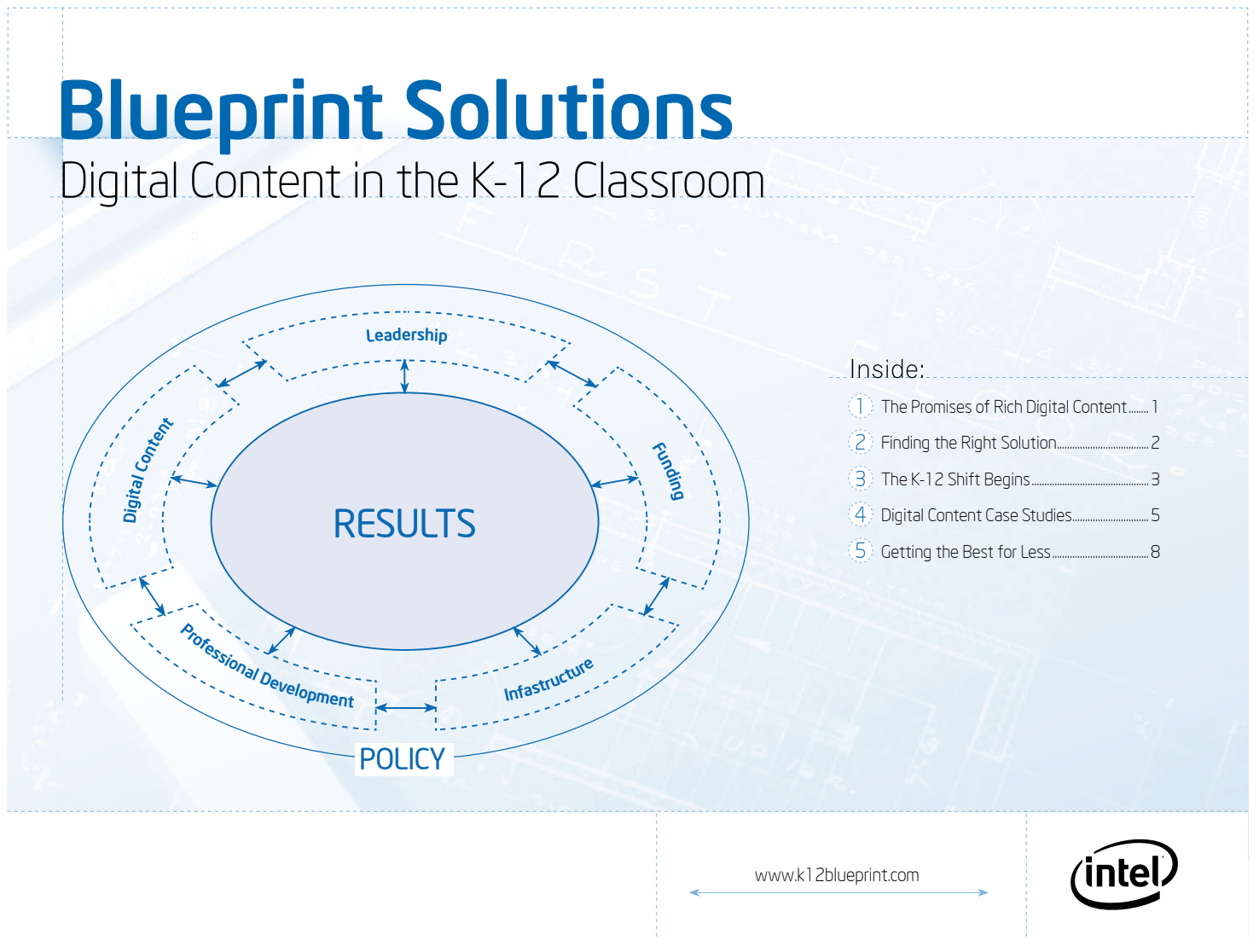
Intel’s 2010 white paper — “Blueprint Solutions: Digital Content in the K–12 Classroom” — neatly captured the Zeitgeist. Having to manage inventory and space also made material inequalities between schools and students more apparent, and a deluge of newly available statistics about spending, performance, and all sorts of other patterns was making educational inequality starker and more consequential.
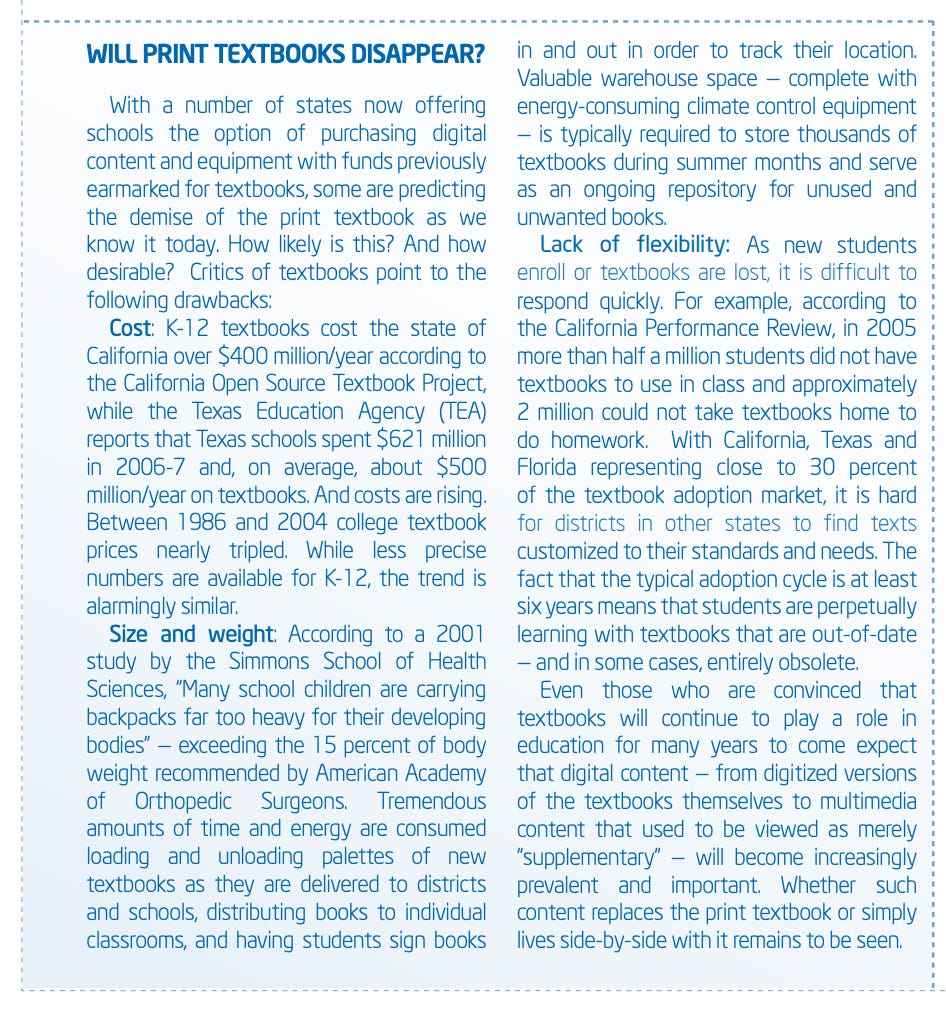
This section lays it all out. The cost of textbooks had been rising dramatically for decades, nearly tripling (for college textbooks) between 1986 and 2004. Orthopedic surgeons were raising the alarm about the physical dangers of too-heavy backpacks. “Valuable warehouse space — complete with energy-consuming climate control equipment” was needed to store the books during summer months, and the sites became Temples of Waste as unwanted or old materials accumulated.
More important, instructional materials were frequently the most visible locus of the struggles that more often confronted the poor, the disabled, and the disadvantaged students. As the white paper notes, in 2005, California reported that over half a million students lacked access to textbooks in class, and 2 million students “could not take textbooks home to do homework.” Access was just one prong of the problem, though.
Textbooks were usually updated only after five, seven, or sometimes even ten years, and these timelines introduced a number of recurrent problems, especially for poorer schools. These cycles greatly increased the consequences of committing to subpar textbooks, or overlooking a supposedly innovative curriculum that was in vogue. Missing out on “easy” improvements to student performance would have made the rigid top-down incentives of the time sting even more, and there was of course the moral cost of providing inferior or out-of-date instructional materials to your students, depriving them of educational opportunities available elsewhere.
The physical infrastructure for analog materials also required its own bureaucratic apparatus. The drudgery of textbook procurement, storage, distribution, and replacement constantly confronted teachers and administrators alike; the possibility of eliminating any one of those would have been enticing. Digitization was thus appealing both to everyone’s moral senses and to the practical sensibilities of the practitioners.
But just because more students can “take a digital textbook home” does not mean that iterating on last year’s logistical issues actually solves students’ educational breakdowns. Maybe, as I’ve been told several times, they or their parents sold their school-issued device and said it was stolen. Or maybe it was actually stolen, or used to play video games and no one was around to tell them not to. Distributional or logistical issues were in this way often conflated with learning issues. A child who cannot take a textbook home has, genuinely, suffered a “learning failure”, but the essence of the failure doesn’t have to do with how the school or teacher understands learning. Digitization made materials lighter, theoretically cheaper to update and maintain and distribute, and most importantly easier to access. What digitization did not do, and what nobody proved it could do, was effectively replace analog childhood learning.
Access became a synecdoche for educational progress, but this was naive. The revolutionary atmosphere had positioned ed-tech as the solution to myriad equity and accessibility issues that had plagued education policy for years.5
Everyone also just seemed afraid; afraid of missing out on the digital revolution and being left forever behind as a result. Millions of Americans had just lost their jobs or their homes during the 2008 Great Recession, after all, so the stakes for everyone and everything felt higher.
At the time, computer coding was also far and away the most exciting new career opportunity for high school and college students. (And it was an early pillar of massive open online courses, or “MOOCs”.6) Though I ended up a “word-cel,” I took part in the early iterations of my high school coding and robotics classes. Because all of us had a solid foundation of analog learning — among other factors7 — we managed to pull off a “work hard, play hard” attitude with the fancy CAD-capable laptops and the flood of resources my school put into our program.
And flood the program with resources it did — I remember grumblings from other departments, like Music and Fine Arts, about how much money Robotics and Coding were getting; but hey, that was the future. And so robotics classes eventually came with a laptop and device upgrades for our cohort, which then became a WiFi/network upgrade for the whole school, and so on. (“Remember class, we aren’t learning how to build drones; we’re building “UAVs”.)
I experienced a privileged version of this tech transition, but the underlying dynamics were present in any school undergoing a rush of new funding for the learning architecture of the future. The problem, I think, is that self-directed digital learning, one-to-one devices, MOOCs, and unsupervised tinkering are most appealing to a highly ambitious and intrinsically motivated subset of students. And as it happened, the founders and C-suites of the major tech companies who were digital learning’s strongest warriors were all exactly this kind of incredible outlier for whom self-direction worked, who thrived in a world of digital distractions. For the motivated and obsessed, most of the downsides of the digital environment could be transmuted into learning advantages. In this way the “future of learning” picked winners and losers from the start, but the thought, or rather the hope, was that it was going to be for everyone. So long as every student could have a laptop and knew how to navigate the internet.
So-called “21st-century learning” thus evolved into its own educational movement, built on assumptions about the future economy and media environment on the one hand, and seemingly undeniable enrollment, economic, and social trends on the other.
But the fervors of the Scholastic Thermidor ultimately pushed schools into an economic arrangement they never signed up for. A decade of digital piracy and cheaper, more powerful devices and WiFi had birthed a new kind of seller’s market: the digital subscription model, or “Software as a Service” (SaaS).
4. District-2-District, Software-as-a-Civil-Service
As educational software became a professionalized service, an entire new ecosystem of managers, products, contracts, and middle-men was unleashed on the schools. The shift happened in three stages, but until it all collapsed each stage felt better than the last — like an arthritic frog getting boiled, except a plague somehow killed it first. (We’ll get to Covid next time, in Chapter 2.) There are finer-grained distinctions that we’ll discuss more in the next post, but the basic evolution of the economic and user models of ed-tech went something like Hardware → Software → The cloud.
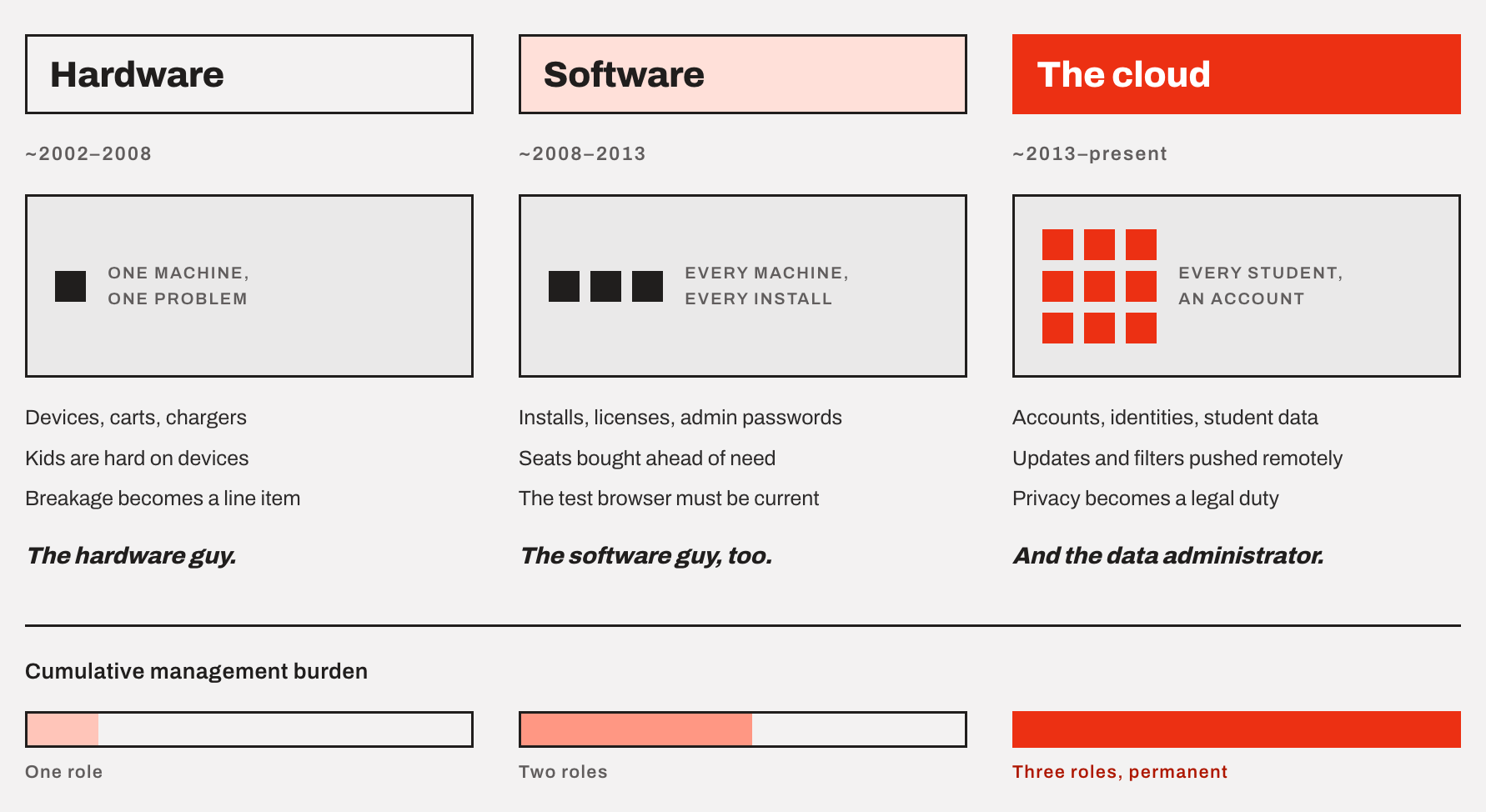
Improvements in hardware costs, accessibility, and eventually student personalization were eagerly integrated into schools’ existing tech stacks. However, as the task of managing school technologies grew larger, so too did the shadow the new system cast over the educational ecosystem as a whole.
Hardware. Up until my middle school years, school technology took up about as much space as any one classroom did. The pedagogical footprint of the computer lab, and even to some extent laptops before one-to-one policies, looked rather familiar: teachers and students used them when it made sense to use them, and when typing classes or supervised classroom laptop time needed to end, everyone packed up and went along to the next period. What ed-tech-qua-hardware required, then, was quite sparse; learning how to use Word or PowerPoint on a 2004 iMac didn’t even require an internet connection! What was needed was the hardware guy, and for a time his role looked much like any normal “IT guy” or technical support position. Kids were hard on the devices, after all, and teachers sometimes had trouble getting the dongle and the projector to work.
Software. Sometime before 2010, software products started becoming indispensable to an increasing number of basic school functions. As I mentioned earlier, part of the reason for the growth of ed-tech-qua-software was just the huge convenience factor. Digital textbooks, for example, were still representations of the physical books; but now hundreds could be stored on a shared classroom machine, and students could start to access them all from one device, whether brought to them in class via cart, or bought for them by their school. Teachers were also able to scan or print excerpts from a single digital copy, so now it would matter even less if a student forgot their physical materials, where those were still being used.
What this evolutionary stage required was the software guy. As the number of ed-tech products expanded from a coterie of devices and routers to different digital textbooks and testing softwares, someone had to make sure every laptop on the cart or in a backpack was properly updated. If the browser or operating system wasn’t up to date, the student wouldn’t be able to properly take the digital test; and so on. After the test, someone from IT would have to go and extract the data from each individual computer, at least for a time, and so of course this required a more robust staff — and a staff that was increasingly becoming a necessary touchpoint for the everyday functioning of the classroom.
The cloud. One oft-forgotten element of school economic life in the prior stage was how often schools overbought educational software. The era of the unlocked PDF file accompanying a textbook was short-lived, in part because innovations outside ed-tech — in software distribution and purchasing, i.e. Software as a Service — were starting to work their magic on consumers’ wallets and big tech’s bottom line. Digital textbook and testing programs started to be sold in bulk seat packages, and schools frequently bought more seats than they needed, because ensuring every student could test was by far the more important priority. The solution to this overbuying? Individualized student accounts.
At some point, several different forces combined to enact the Software → Cloud shift. When laptops became cheap enough for every student to have them, and when WiFi and internet access became reliable and ubiquitous enough, it finally became possible for students to have unified digital accounts for school and all the ed-tech services used therein. This shift created the need for schools to have an additional managerial layer: data management and cloud services administrators. They weren’t managing software, and they weren’t fixing hardware, but instead managing student accounts, software serial number registrations, Apple school devices, and device permissions. These new cloud management roles couldn’t be mere auxiliary or low-status ones, though, because student data still had (and still has) some of the most stringent data-rights and privacy protection safeguards under US federal law. And so schools were going to make sure this new admin class had the tools it needed to make sure that their students’ data didn’t get stolen, lest a big lawsuit or state investigation come knocking.
The subscription/management trap. Taken together, the three stages of the ed-tech revolution I describe here brought about two seismic shifts in the economic and day-to-day operations of schools that they and society, at least in hindsight, seemed to miss. The first and more straightforward one is just that the ed-tech economic model schools are now chained to was not what anyone expected. Saddled with the experience of textbook procurement cycles, the thought of being able to simply avoid all of the physical toil and inventory maintenance expenses was made much more enticing by the fact that no one knew the kinds of economic models that were about to arise from the software space. So now schools are stuck paying every year, for nebulous software innovations, and the accessibility innovations didn’t seem to move the needle at all for student learning.
The second shift is less straightforward. But the basic idea is that everyone underestimated what managing student accounts, one-to-one devices, and digital learning would actually do to the classroom. Instructional time starts to bend around an infrastructure that has taken on a new purpose — not merely for accountability, but for pedagogy, too. How much is bent, how far, and what all this has broken is the subject of the next chapter.
For a couple years, though, the future of ed-tech wasn’t so clear.
The above process encountered at least one major structural barrier in 2011, when Congress zeroed out the major federal funding scheme for getting ed-tech into schools. Between 2002 and 2010, over ~$3.5 billion dollars had been earmarked for the Enhancing Education Through Technology program. The program had been far from streamlined, and half of the funds had to be distributed by the states via competitive grant applications which, unsurprisingly, were bigger burdens for low-income and staff-crunched districts. The applications also took up an increasing amount of district bureaucratic horsepower to submit, potentially win, and then have to faithfully implement. So a year after the Obama-era Department of Education itself recommended cutting the program, Congress obliged.
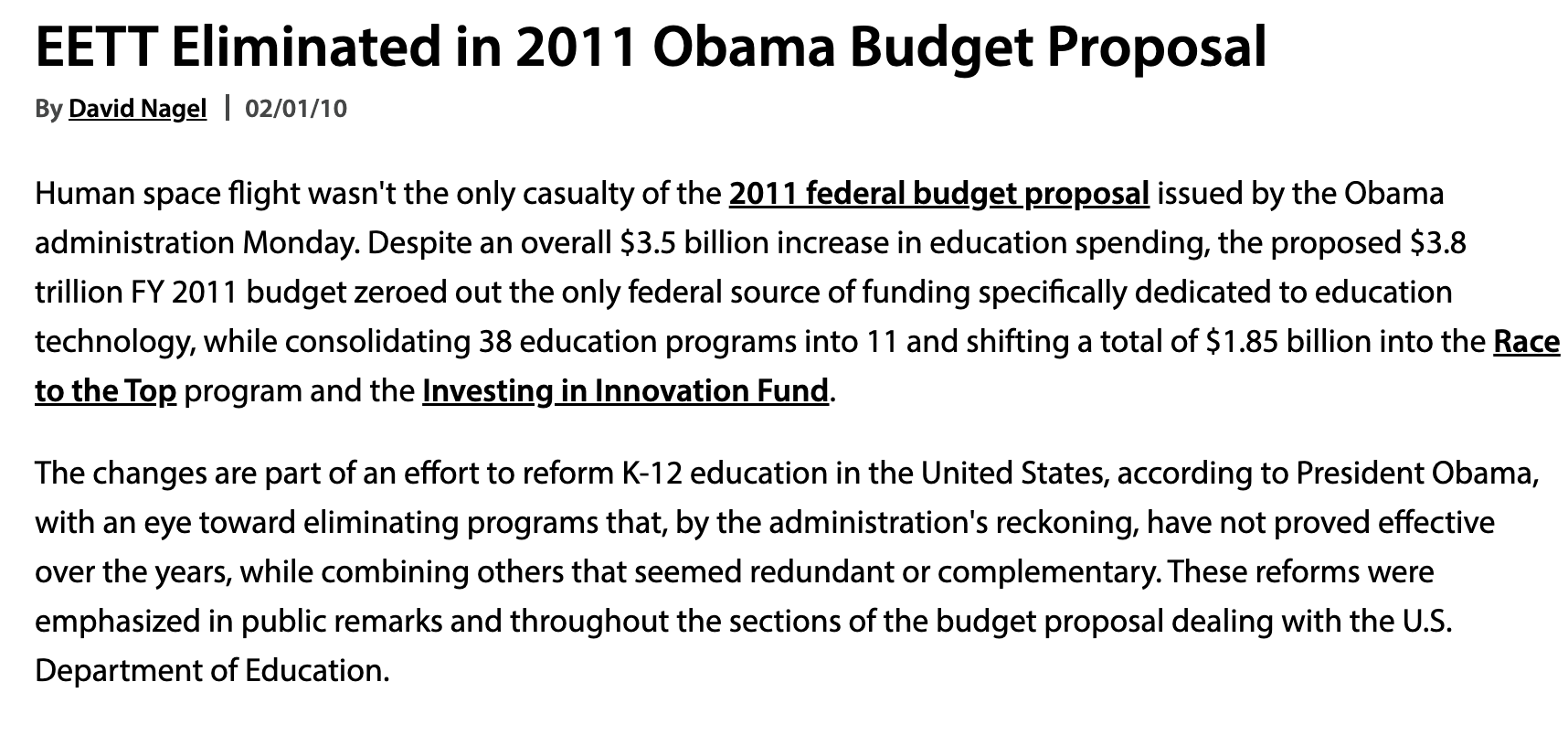
Federal funding had not been cut because America was collectively starting to rethink the ed-tech revolution, though. Every school and district still felt the pull of the era to digitize their classrooms and bring learning into the 21st century, but now without the financial support of the federal government. Stories like this one from 2014 were becoming increasingly common:
Ryan Imbriale had a quick and concise answer when asked whether his school district, Baltimore County Public Schools, received enough state funding to pay for its transition from textbooks to software: “No.”
As executive director of the district’s innovative learning department, Imbriale is overseeing a five-year project, called BCPS One, to move its entire curriculum online and make it available to teachers and students. He estimates that the district will spend more than $1 million a year on digital resources for its 108,376 students. The district was “lucky enough,” he said, to get one of the governor’s innovation grants.
On the other side of the country, the San Francisco Unified School District pays about $800,000 a year for software licenses and maintenance. Even with discounts from the companies, “the price tag is beyond the budget we get from the state” for technology, said Chief Technology Officer Matthew Kinzie. He said the district is seeking grants and donations to cover the costs.
But depending on these occasional infusions of money and continuing to look for outside resources isn’t practical.
The Wild West period of ed-tech funding could not last long, at least not like this.
5. Every Student Succeeds
By December 2015, America put a stake through the NCLB era with the ratification of the Every Student Succeeds Act (ESSA). ESSA was less a cause of the retreat and more a formal recognition that NCLB did not work out as well as hoped. Three years earlier the Department of Education had walked back the “Adequate Yearly Progress” accountability system that over half the states were failing to meet. The 50 states — even the states doing well — were tired of the atmosphere of over-optimization and punishing incentives. Now it was up to them to develop their own standards and methods for holding schools accountable. So long as they continued regular yearly testing on state standardized tests, of course, with at least 95% of students (and 95% of each student subgroup) participating.
Importantly, ESSA also amended the Title IV-A funding scheme to simplify the highly fragmented system that had grown under No Child Left Behind, creating three pillars of activities for which IV-A funds could be used: Activities to Support Well-Rounded Educational Opportunities; Activities to Support Safe and Healthy Students; and Activities to Support the Effective Use of Technology.
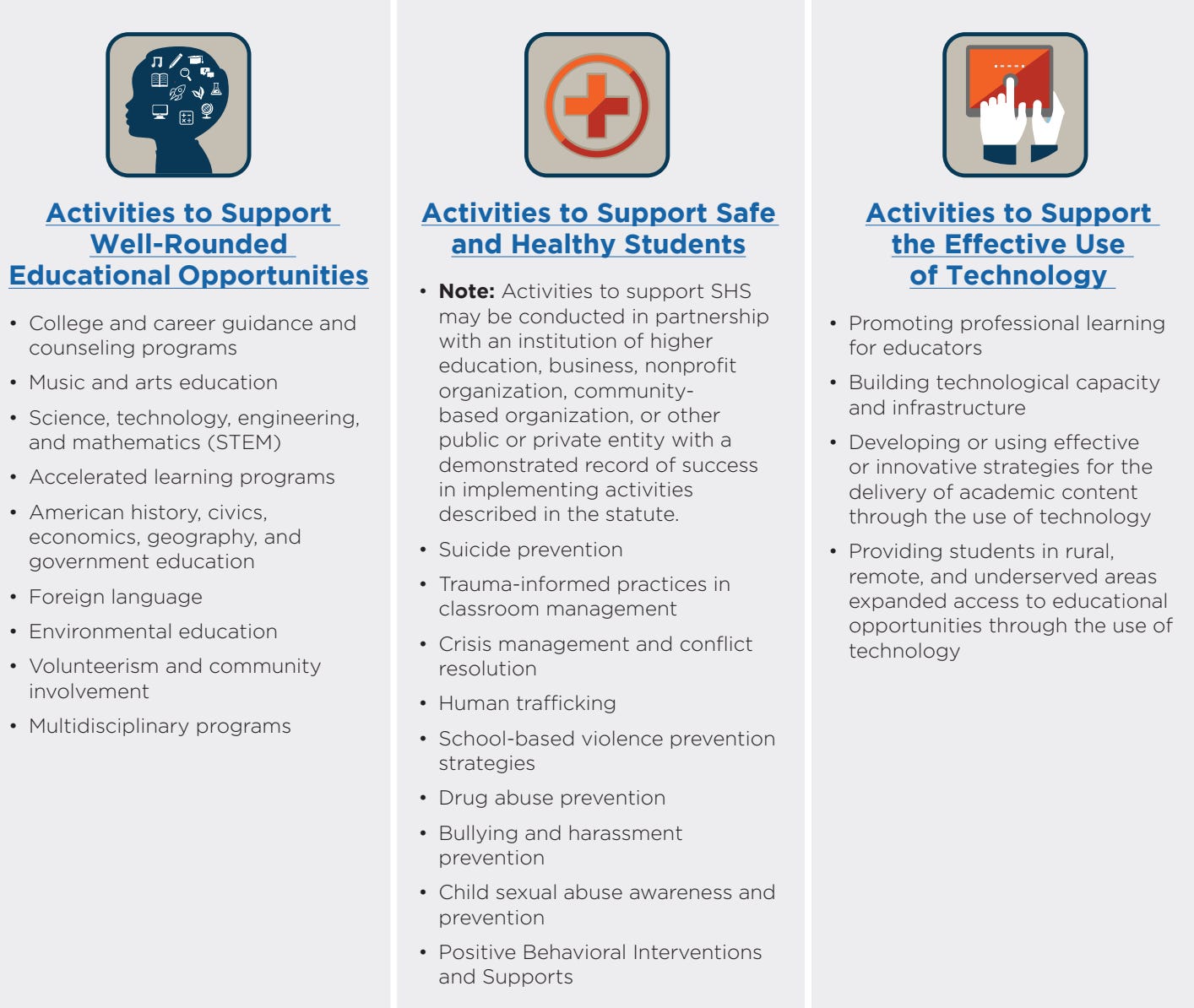
In its deliberative wisdom, Congress foresaw some of the dangers of large, unrestricted funds for technology in schools, and so it put a 15% cap on how much of the third pillar could be used “for purchasing technology infrastructure” (one-off device and software purchases, WiFi and router upgrades, etc.). The rest had to be used on more “human” activities, like teacher and student training, or developing new digital-first or blended environment courses.
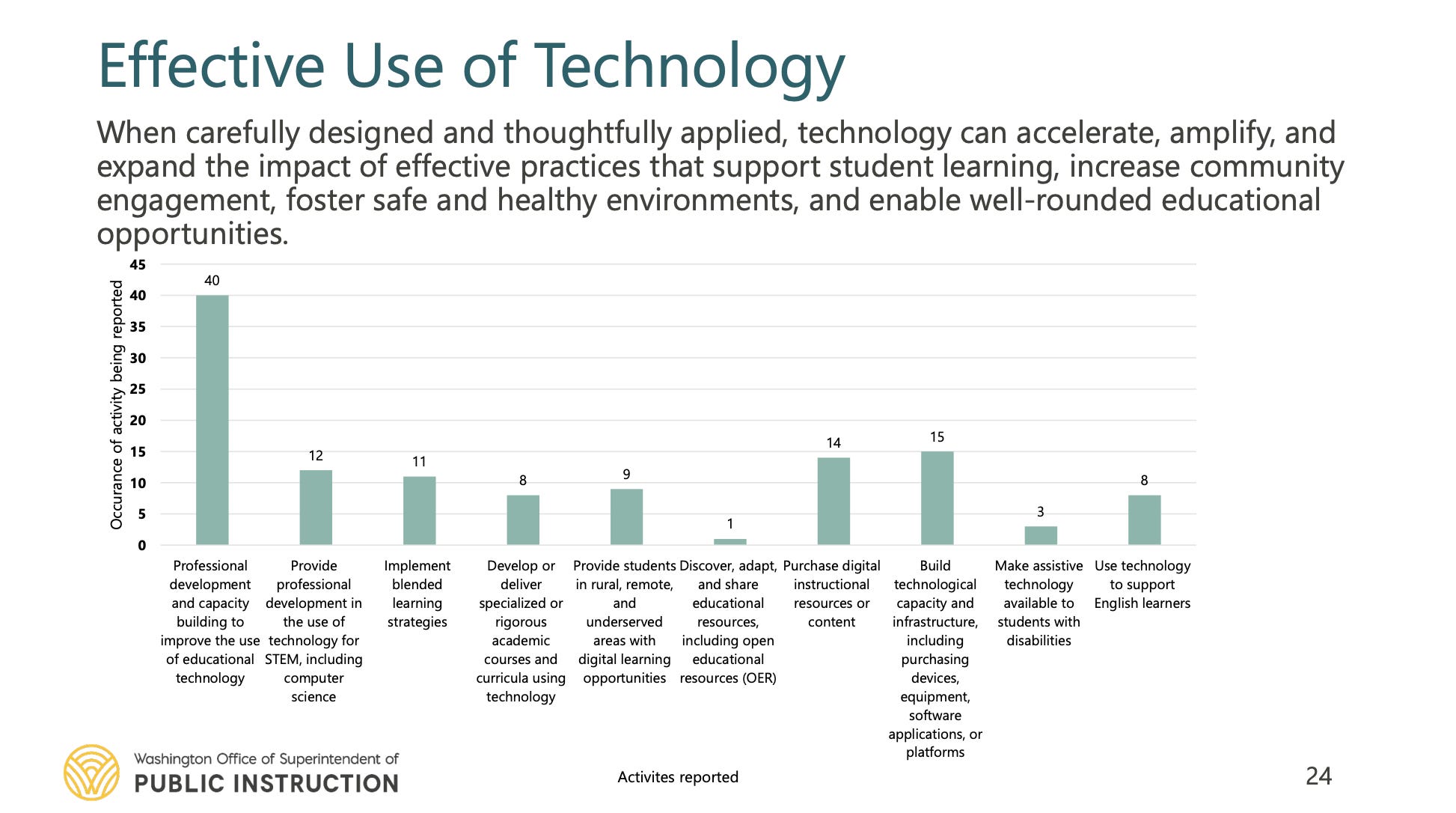
The dividing line between “technology infrastructure” and other expenditures was not so neat in practice, though, for two reasons. First, as this presentation from the Washington state education agency might illustrate, the categories have a bit of play in their definitions. Purchasing a software suite to have on hand might trigger the 15% cap, but what if it is for a new course designed to foster digital citizenship? Or what if a new professional development course requires a WiFi overhaul? The boundaries blur.
Second, there is also some play in how districts can allocate funds across ESSA block grants. For example, they can elect to transfer Title II-A funds (for “Supporting Effective Instruction”) or Title V-B funds (for “Rural Education Initiatives”) to the Title IV-A bucket, effectively raising the 15% cap on purchasing tech infrastructure.
One possible reading of ESSA, therefore, is that it formalized our collective backtracking from the accountability revolution and its failures, but at the same time stimulated the embrace of the technology that had grown around that old system. That is, ESSA radically pulled back federal accountability standards — no more Adequate Yearly Progress, no more uniform benchmarks — while expanding federal funding and support for the tech stack those standards had required. Every state would still require yearly testing, but now they had to figure it out themselves. And of course they still had to prepare students for the 21st century.
Districts now had new ways to earmark more and more money for technologies meant for an infrastructure that had outlived its original raison d’être, and overlapping moral incentives to do so as fast as possible.
So why do kids need to understand how to use devices, before many can even read? Because assessments are administered on devices. Why does that matter? Because those assessments are used to evaluate teachers. And so a teacher, who knows that their job is based on students successfully performing on devices, is going to introduce students to devices earlier than they need, to ensure that they have the background knowledge and skills to use that device effectively when it counts. It literally does not matter at all whether this belief is true, because the incentive is built into the core structure of the education system.

6. Two Kinds of Looking Glasses
The promise was that a revolution was about to take place in teaching and learning, in the cradle of inexpensive laptops and digital interfaces. At the time “What else could the future have in store?” must have seemed an abundantly reasonable thought for many professionals whose careers were increasingly playing out via email. And yet —
The screens that looked at students became the screens that students looked through. A tech stack propagated to serve an accountability architecture was transmuted into a vessel for the future of learning, and spawned all the products and software services that came along with that. So it did not work and, as it was, it was never going to work, because no one proved that pedagogy could be digitized. Nobody produced a body of scholarly research showing pedagogy or learning could simply transfer onto screens.8 The education academies were asleep at the wheel.
The fact that a vigorous theory of digital pedagogy did not emerge — instead just a split between doomsayers on one side and surveyors and purveyors on the other — is prima facie evidence that the first ed-tech revolution was in fact something else. Lacking a working theory of how learning might constitutively change if it takes place via laptop screens and interactive software, education was ripe for disruptive innovation posing as genuine educational progress.
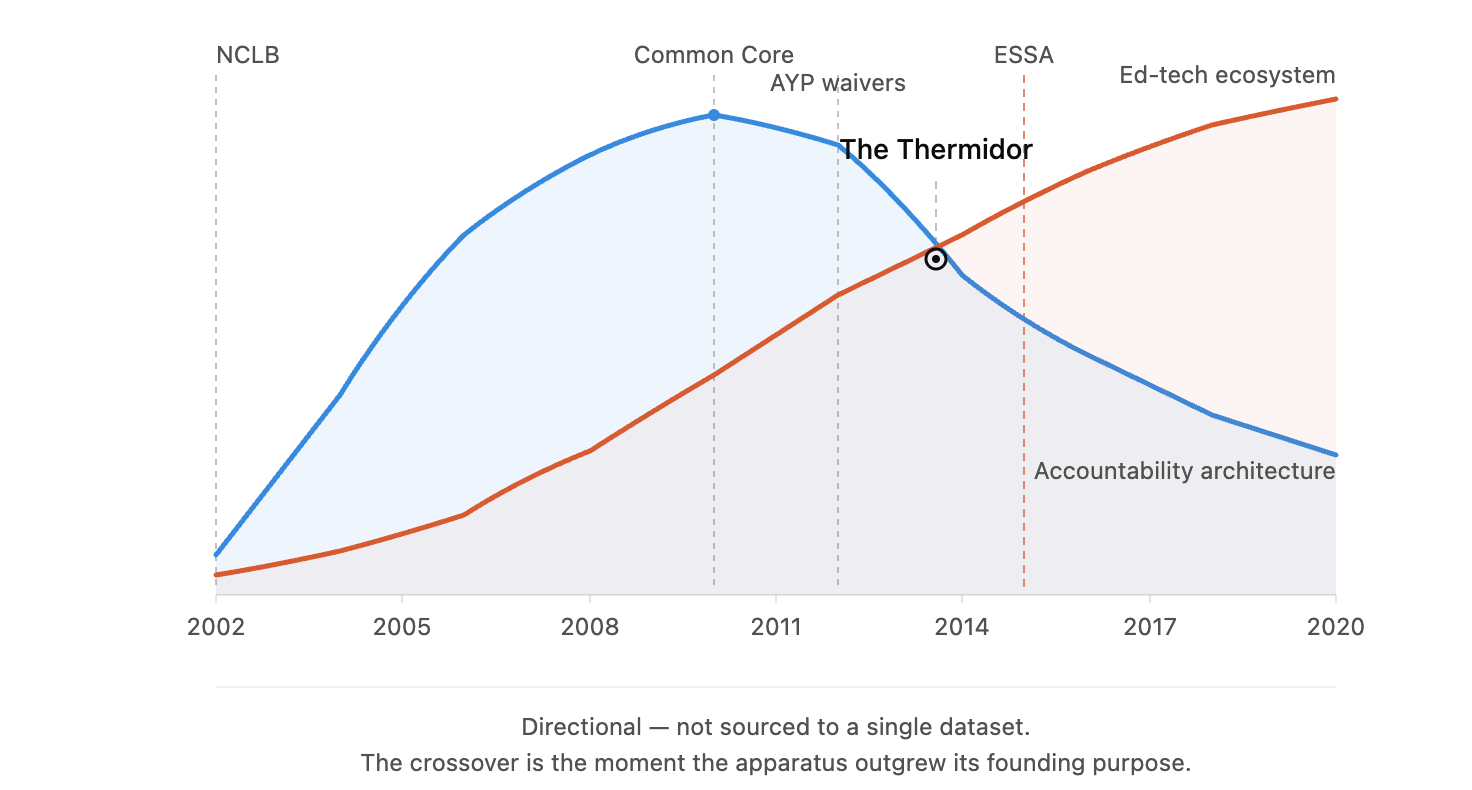
Now we’re caught in the gloom of the Scholastic Thermidor, and we’re confronting a new technology that finally makes the kind of ed-tech revolution everyone was vaguely imagining possible, at least in theory. Yet memories of the first revolution haunt us, so what we see approaching has the likeness of a monster.
Thankfully, whether it becomes one is up to us.

Thanks to RHG Burnett, Alex Araki, and Cooper Kramer for helping me develop the ideas for this series.
The October Revolution of 1917 was a violent, undemocratic coup in which Lenin and the Gang betrayed Russia’s democratic, popular uprising (the “February Revolution”) that had taken place earlier that year. So Trotsky was mostly being a sore loser, and also something even worse: an antidemocratic sore loser.
Born with a fatal flaw: Why should all students learn at the same pace?
These proved double-edged.
For students who depend on screen readers or text-to-speech, digitization was a genuine breakthrough. The irony is that these real accessibility and accommodation gains became part of the justification for a much broader transformation that had nothing (or maybe everything) to do with accessibility.
Higher education institutions were also feeling the pressure, and how they reacted to the digital learning revolution greatly accelerated it. Around the turn of the decade, colleges and universities were enrolling more students than ever before, reaping the benefits of the “college for all” cultural and policy environment. But by 2013 higher ed had seen its second consecutive year of enrollment declines, with 300,000 fewer students enrolled than the year prior. Customer satisfaction thus became a top priority, and so when students started rebelling against the high costs of textbooks and learning materials, higher ed institutions listened.
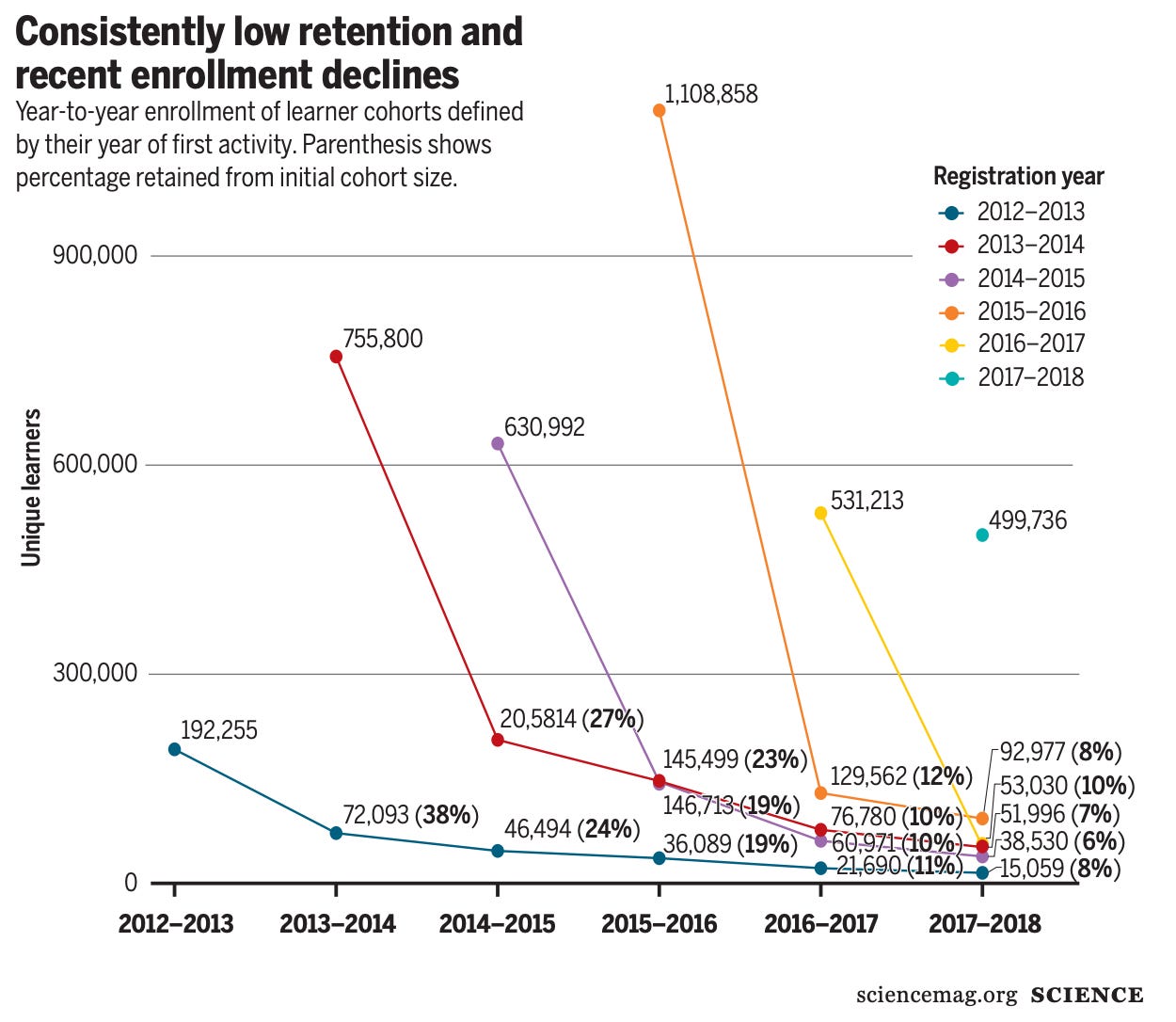
This enrollment crisis also coincided with the meteoric rise of a new competitor for colleges and universities: massive open online courses (MOOCs). In hindsight it seems that MOOCs — like much ed-tech — were not for everyone. Low-cost and easy-access allowed an explosion of students enrolling in the open online courses, but lacking rigid structure and traditional modes of credentialising meant that higher ed’s supposed new competition had a half life. While more people were signing up for MOOCs every year, an increasing portion of those who had enrolled were deciding to quit.
We were also lucky that our teacher and coach, Michael Snyder, was probably in the top percentile of tech educators in the country. My teammates were also much more talented than me. But as local news described back in 2012, “Flint Hill School Robotics Dominate Competition.” Nice. The photos of me from high school? Not nice.
Jared Cooney Horvath has been wonderfully chronicling the saga over at his Digital Delusions Substack.
My goodness, I forgot all about miniclip games! I remember playing on that site in so many ict classes.