


Sandeep Kaushik is a political consultant and former journalist in Seattle. He currently co-hosts Blue City Blues, a podcast about urban America and its discontents.
In one of Aesop’s fables, a dog crossing a bridge with a tasty piece of meat catches sight of its reflection in a stream. Thinking it sees another who’s found one even bigger, the dog urges forward, opens its mouth, and loses its dear meat downriver. Today, guest contributor Sandeep Kaushik brings us a saga about a similar creature, a well-meaning urban school district that lost sight of achievement- and accountability-based reform in pursuit of whatever purported to put equity first. From eliminating advanced programs to subverting student standards, Seattle Public Schools has selected radioactive means to realize identitarian ends, and the most vulnerable students are the ones who’ve paid the price. What follows is a long and gripping story about hindering progress, one that it’s time for the district to redress.
Attacks on Excellence is a series from Education Progress featuring critical coverage of the education policies and research paradigms that are holding students back.
The fastest-growing big city in the United States during the 2010s, Seattle is a knowledge economy superstar. Seattle not only boasts the third-highest median income among the 50 largest American cities, but also is the most educated major city in the country and among the most literate, with more than 70 percent of residents over age 25 holding a bachelor’s degree or higher. Seattle is also one of the country’s most politically left-leaning cities (like Zohran Mamdani in New York, Seattle’s recently elected mayor, Katie Wilson, is a self-described socialist), one that conceives of itself as a Disneyland of progressive public policy imagineering, where elected officials vie with one another to lead on incorporating au courant activist ideas and cutting edge cosmopolitan cultural commitments into governance.
Not coincidentally, Seattle’s public school system has foundered over the last decade, beset by declining enrollments, serious budgetary challenges, and mounting safety issues. Seattle’s test scores, while still relatively high overall, have lost significant ground compared to the national average. Perhaps most concerning of all given district leaders’ oft-proclaimed fixation on equity, Seattle’s public schools have in recent years produced ever widening achievement gaps, even as the district implemented comprehensive systemic changes intended to shrink these gaps.
Forces beyond Seattle Public Schools’ (SPS) control, like inadequate state support for education, the rise of smartphones in and outside of the classroom, and the disruptions of the COVID era have certainly contributed to the district’s troubles. That said, many of the problems afflicting the district are self-inflicted wounds. Dating from well before the pandemic shuttered schools, Seattle school district leaders made a series of purposeful, ideologically driven decisions to lower academic and grading standards, hollow out the district’s once thriving gifted and talented program, loosen discipline and consequences for truancy, and limit educational opportunities, and then compounded the litany of bad choices by demonstrating a willful blindness to their decisions’ negative downstream results.
As such, what happened in the Seattle Public Schools — just as much as the higher profile pandemic-era meltdown in the San Francisco Unified School District — stands as a cautionary tale of how good progressive intentions can go terribly wrong, and as a microcosm of how the national turn in some of the country’s most educated and economically successful blue jurisdictions over the last decade away from a focus on accountability and academic achievement in schools has turned into an extended exercise in self-sabotage. The result has been the educational short-changing of children of all races in Seattle, but with particular harm caused to poor and minority children.
NURTURING, NOT JUDGING
The top-line narrative of Seattle Public Schools’ past decade is the story of a comprehensive, even radical, internal cultural and pedagogic shift. The reset is broadly characterized as a turn away from a reformist culture built around instituting multiple layers of accountability (for students, teachers, and schools) that was intended to maximize academic achievement, to one fixated on warmer, less prescriptive, therapeutically tinged pedagogical approaches designed to foster a sense of identitarian belonging.
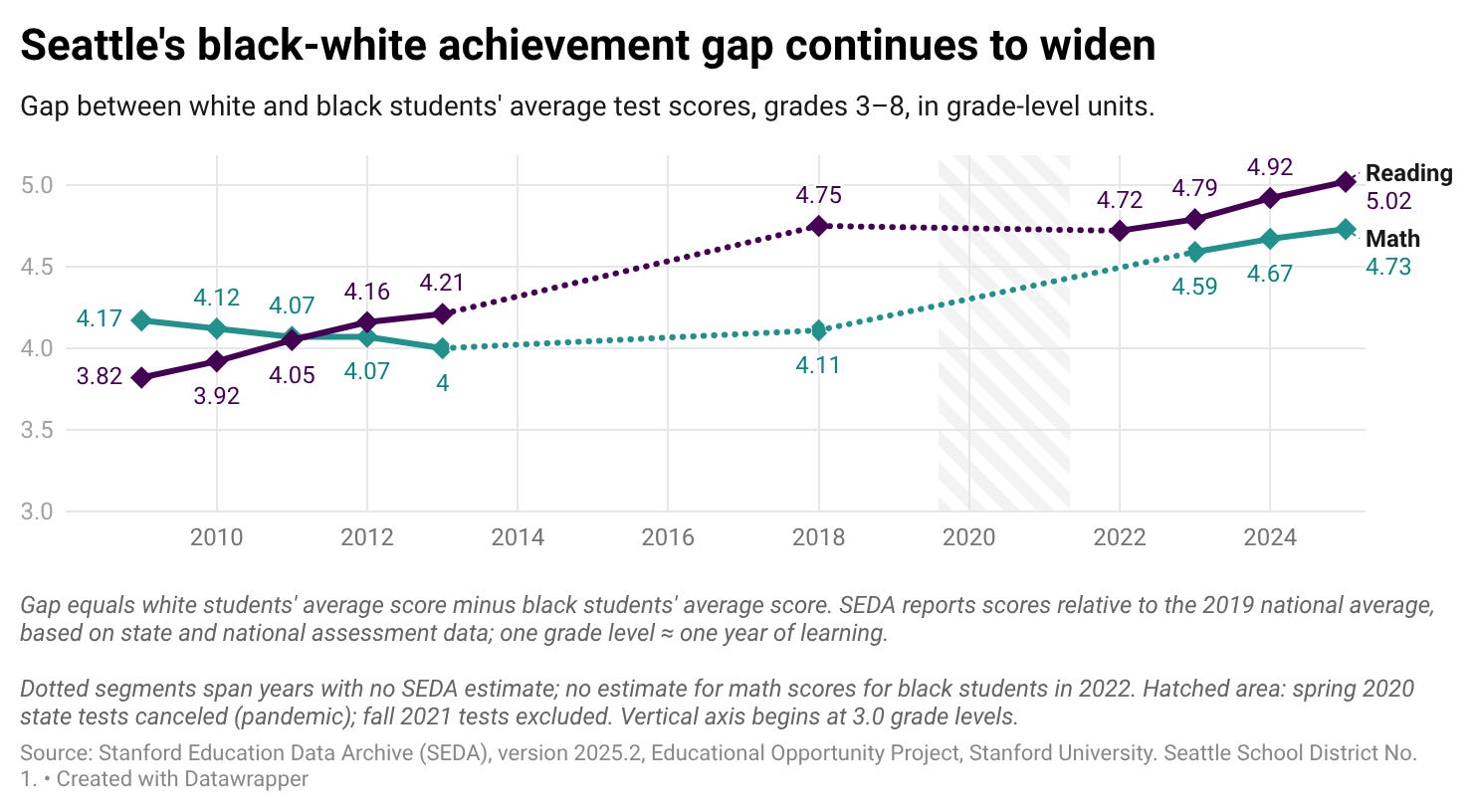
In keeping with the national Democratic Party’s embrace of education reform in the early Obama years, SPS from 2007–11, under the direction of then-Superintendent Maria Goodloe-Johnson, became intensively focused on boosting student achievement and school and teacher performance. And those efforts bore fruit: according to the Stanford Education Data Archive (SEDA), produced by Stanford’s Educational Opportunity Project, Seattle students’ average test scores were 0.7 grade levels above the national average in 2009. By 2013 they had risen to 1.43 grade levels above average, finally peaking at 1.68 above average in 2018.
The rapid academic gains may have been real, but not everyone was pleased with the way they were being achieved. By the early 2010s, many progressive Seattle teachers and activists had joined forces with racial and social justice organizations to push back against what they saw as culturally inappropriate testing and academic accountability regimes that were unfair to children of color. In 2013, this opposition went national when some local teachers launched a defiant boycott of standardized tests, winning support from leaders of national teachers unions and other prominent progressive education advocates like Noam Chomsky, Diane Ravitch, and Jonathan Kozol.
Already in 2012 the district had adopted a new foundational policy for “Ensuring Educational and Racial Equity” that among its other elements mandated district schools offer a “welcoming culture and inclusive environment” for students. By the time Congress replaced No Child Left Behind (NCLB) and its accountability mechanisms in 2015, SPS was well on its way to unwinding what had come to be widely perceived as a cruelly indifferent, unfeeling, and counterproductive fixation on measurable outcomes. In its place, SPS moved to implement policies centered on making students who had previously been deemed underperformers, particularly black and brown students and those of lower socio-economic status, feel affirmed in Seattle schools. As the 2012 equity policy explained it, “A student whose history and heritage are appreciated and celebrated will learn better and be more successful than if that student is forced to overcome a cultural barrier.”
In short, a new organizational culture rapidly took root, committed to reforming the educational experience root and branch to incorporate new equity-focused, identity-based anti-racist approaches. Where previously the school district had seen its task as helping children from disadvantaged backgrounds to acquire the skills they needed to meet the district’s educational mandates, the new thinking was that it was the district’s obligation to adjust its mandates to better accommodate the children who were falling short. This new dispensation, with its “multiple pathways to success” (as the equity policy required) would eliminate the stubbornly persistent gaps in achievement between black and Latino children on the one hand, and Asian and white children on the other.
That this is the wrong way to apply equity principles, that it doesn’t actually improve the academic performance of poor and minority kids, and that it might alienate families with higher-achieving children, didn’t seem to matter.
By any measure, Seattle’s public schools had performed poorly on addressing racial disparities in the NCLB era, despite recognizing wide achievement gaps as a problem for decades. When Stanford analysts first released SEDA in 2016, they found that Seattle had the fifth-biggest achievement gap among the 200 largest school districts nationally, with black children performing 3.5 grade levels behind their white peers — roughly 4 grade levels on the current scale. So at the outset of this cultural shift a decade ago, a hard break with the past seemed long overdue. Equalizing outcomes became the new north star for Seattle educators, and it quickly morphed into the district’s singular focus for driving changes that SPS decision makers expected would finally create a fair and just educational experience for the children in their charge.
On that basis Seattle Public Schools embarked on a sweeping set of what might be called “equity-reductionist” policies. In the older reform framework, eliminating inequitable group outcomes across divides of race and class was one goal among others in an array of desired educational outcomes. But now that array was reduced to just one, a singular consideration driving the decision-making of district leaders. Equity trumped all.
District leaders’ narrowed focus on engineering equal outcomes also carried the risk of being reductionist in a second sense: if equal outcomes were the only results that mattered, then it suddenly made perfect sense to reduce standards, eliminate choices, and force all children, especially higher-achieving ones, into a one-size-fits-all pedagogical box providing the quickest path to get there. Under this sort of equity-reductionist mindset, working to ameliorate performance barriers created by racial and class divides was not nearly enough; seeking to erase differential outcomes rooted in natural aptitude and ability became fair game as well.
That this is the wrong way to apply equity principles, that it doesn’t actually improve the academic performance of poor and minority kids, and that it might alienate families with higher-achieving children, didn’t seem to matter. The only thing that did was that the district moved boldly and decisively to try to ensure all identity groupings — and really, all individual children — performed as close to equally as possible, particularly by eliminating any educational programs that were disproportionately enrolling white and Asian children.
DETRACKING TO END “EDUCATIONAL REDLINING”
This is exactly what happened in the Seattle schools. By 2016, progressive members of the Seattle School Board, SPS central-office policymakers, and some prominent school principals had concluded that if differences in outcomes were going to be meaningfully addressed, radical curricular and pedagogical change would be needed. They began by experimenting with ending the practice of tracking students into distinct ability groupings based on testing results. Black and Latino students had been persistently under-enrolled in higher-level honors courses; thanks to promotion by anti-Common Core educator and detracking advocate Carol Burris, the belief took hold that eliminating those standalone courses, and combining higher-achieving students in the same classrooms with lower-achieving ones, would improve outcomes for all.
First on the chopping block was the district’s Spectrum program, which offered separate classes for children who had demonstrated the capacity to complete academic work one grade level above their age cohort. After a brief pilot in one school of reintegrating Spectrum kids into regular classrooms showed promising preliminary results, beginning in 2016 Spectrum classes were eliminated in all elementary and K-8 schools, and the district began piloting an effort to eliminate standalone honors classes in high school. The elimination of Spectrum in middle schools followed in 2020.
In 2019 a task force of parents and educators previously convened by the district was deep into the process of developing a set of recommendations calling for the district’s crown jewel, its highly subscribed-to, top-tier gifted and talented program, the Highly Capable Cohort (HCC), to be reformed to boost minority enrollment. But a vocal contingent of progressive activist school board members, impatient with bureaucratic process and time-consuming stakeholdering work, was already convinced that HCC was at the core of the district’s inequity problem. Moreover, the very idea of a separate program for gifted children violated their now ascendant equity-reductionist principles. Even before the task force could issue its proposals, the board’s progressives moved to kill the program, prodding then-SPS Superintendent Denise Juneau to declare war on HCC, which at the time enrolled nine percent of SPS students.
Juneau publicly denounced HCC as a “program of segregation” rooted in “educational redlining.” She further claimed that Garfield High School, a storied Seattle school which served as one of the program’s homes, was “Apartheid High” and the “slave ship.” Unsurprisingly, her harsh comments sparked an uproar among HCC parents, who organized to speak out in support of the advanced learning program.
Their pleas fell on deaf ears. When a contingent of minority parents turned out at school board meetings in 2020 to testify in favor of reforming rather than eliminating HCC, Chandra Hampson, an uncompromising progressive firebrand who had just joined the board but was already emerging as the leader of its majority identitarian activist wing, publicly dismissed them as “tokenized” fronts for privileged white parents. Hampson was hardly alone in thinking this way. Over the next five years, activist SPS board members and senior staff developed a pattern of dismissing any criticism of their equity-reductionist policies as emanating from entitled, white parents with retrograde, reactionary politics — this despite the fact that the complaining parents were racially diverse and almost all would self-identify as liberal or progressive.
Despite vocal and passionate parental support for HCC, the board mandated the elimination of standalone HCC classrooms within four years (although last year, in the face of a sustained crescendo of parent complaints, the board extended the date of its final elimination to 2030). Even as the battle over HCC raged, SPS moved in other ways to restrict opportunities for higher-achieving students, including deciding that all non-HCC children through sixth grade would be required to take the same math course, regardless of aptitude. And beyond sixth grade, no child would be allowed to take math courses more than one grade level beyond their current status.
AN ECHO OF SAN FRANCISCO
The board’s palpable contempt for anyone who expressed concerns about its leveling efforts triggered what would become an exodus of families out of the public schools. But the push to eliminate HCC and otherwise hold back higher-performing kids was not the only point of friction. As the pandemic hit and schools shuttered, and passions in the wake of the killing of George Floyd in Minneapolis triggered a frenetic wave of institutional changes across Seattle justified in the name of social justice, the perception began to spread among many parents that the education of Seattle’s children had become a secondary consideration for an increasingly ideologically driven school board.
They had reason to be alarmed that the SPS leaders had perhaps lost the plot. During the pandemic, the San Francisco Board of Education was pilloried by angry parents for putting far more energy into renaming rather than reopening schools. That anger grew after one of the San Francisco board members frivolously sued the district and her colleagues for $87 million after she was reprimanded for offensive tweets in which she used the term “house n****r” to refer to Asians, whom she added used “white supremacist thinking to assimilate and ‘get ahead.’” These antics from board members in San Francisco, which resulted in three of them getting recalled, received enormous national attention. In Seattle, though, similarly eyebrow-raising acts largely flew under the national media’s radar screen, even as they sparked similar parental anger.
Much of that anger, however, was being voiced privately, behind closed doors. Even before Seattle passionately embraced the spirit of the post-George Floyd racial reckoning, one downstream consequence of the district’s uncompromising embrace of equity reductionism was a chilling effect that silenced concerned parents or other observers who questioned whether the district’s new approaches were likely to be successful. Those who voiced even cautious concerns about the changes were angrily denounced as racists. Often leading the charge to silence dissenters was Tracy Castro-Gill, the district’s controversial Ethnic Studies Program Manager who maintained an active online and social media presence and a large support base within Seattle’s identitarian left (Castro-Gill was removed from her position in 2020 after having been accused of bullying behavior and other misconduct). Local media too became noticeably unwilling to probe the district’s major policy shifts that were being justified by the urgent need to address pervasive systemic inequities.
In the summer of 2020, after large homeless encampments formed near two Seattle schools, Hampson and her close ally, Seattle School Board President Zachary Pullin (then Zachary “DeWolf”), preemptively demanded the mayor refrain from clearing one of the encampments, which sat on school property. “We demand sweeps NEVER be performed on school grounds, adjacent or elsewhere in this City,” they wrote. The camp remained there for well over a year, as parents’ concerns mounted, even as several encampment residents overdosed and the school twice went into encampment-related lockdowns. Those concerns only grew as multiple allegations surfaced that the head of the small, dubiously credentialed nonprofit the district engaged to resettle the encamped had instead been spending district funds to buy meth, which he had female encampment residents help him inject.
Remarkably, the spectacle of a sitting school board president suing her own district over being rebuked for bullying black staffers initially received no attention in the local press.
As was the case with the San Francisco board members, Hampson and Pullin appeared far more interested in social justice wins than in establishing effective remote learning efforts or in getting schools reopened. After exiting the school board after one term in 2021, Pullin penned an unintentionally revealing Medium post detailing his term overseeing Seattle schools.
The 4,250-word piece extensively details Pullin’s work with activist students and groups to improve their sense of belonging. Pullin, who also identifies as Native American and queer, spared no effort to make trans, black, Native, and LGBTQIA+ students feel heard. For example, his “LGBTQIA+ Inclusion Resolution” passed by the board in June 2020, three months after Seattle schools closed during the pandemic, included a provision that “requires LGBTQIA+ history, contributions, stories, and achievements be explicitly included in all English and history curriculum.” He proudly touted his successful fight, also accomplished while schools were closed in 2020, to modify district policy to allow students two excused absences a year to participate in climate strikes and similar protest activities.
Yet in this extensive account, Pullin displayed an interest in academic performance and achievement in Seattle schools only twice. First was his celebration of successfully pushing forward a pandemic-period “A or incomplete” grading policy that he told the Seattle Times would ensure “no students are penalized because they might not have the same advantages at home that other students have.” This policy was justified, SPS said in a press release at the time, because “grading has been one of the biggest sources of inequities in education because student performance may be influenced by factors outside a student’s control.” Second was Pullin’s expression of satisfaction with the dismantling of what he called “the trauma of the District’s Highly Capable Cohort” which “has only perpetuated segregation and racism in schools.”
The questionable prioritization continued. In 2021 after a costly outside investigation, both Pullin and Hampson, who succeeded Pullin as board president, were mildly reprimanded by their board colleagues after having been found to have bullied and berated two senior black female staffers. They had been spurred to anger because the staffers had not moved quickly enough, in their view, to develop a new anti-racism policy that Hampson and Pullin felt an urgency to implement. The staffers, for their part, had pointed out that they were busy trying to stand up online learning in the midst of the COVID emergency, an explanation that did not satisfy the board members.
In an eerie echo of what transpired in San Francisco, Hampson responded by suing the district, unsuccessfully demanding the reprimand be rescinded. Remarkably, the spectacle of a sitting school board president suing her own district over being rebuked for bullying black staffers initially received no attention in the local press. After this author learned of the lawsuit from education blogger Melissa Westbrook, I asked her in May 2022 to write a story for a local online news site with which I was affiliated. In a telling indication of the local media’s reluctance to cover the mounting dysfunction within the district, the Seattle Times did not mention the lawsuit until August 2022, when the case was on appeal. Hampson’s appeal, as it happened, was denied.
The bullying behavior surfaced in this incident was just one expression of a growing toxicity and division within the upper ranks of SPS leadership. Superintendent Juneau began privately complaining of being similarly pressured and disrespected; in December 2020 she announced she would not seek reappointment to another term and then resigned early in May of the following year. Board members not aligned with its dominant progressive activist wing also complained privately of being ostracized and targeted; as two board members resigned in early 2024 for no longer living in the districts they represented, they issued a veiled statement alleging they had been targeted by some of their board colleagues. Juneau’s successor as superintendent, Brent Jones, despite pushing to implement their shared agenda, would also run afoul of the board’s identitarian activist wing. After narrowly receiving a one-year contract extension on a split vote in February 2025, Jones announced his resignation the next month.
GOING ALL IN ON EQUITY REDUCTIONISM
The district’s single-minded pursuit of equity reductionism continued to grow. In 2019, along with taking aim at the HCC program, district leaders loudly proclaimed that they were “laser focused on supporting Students of Color who are furthest away from educational justice” by “disrupting the legacies of racism in our educational system.” Achieving the district’s five-year strategic goal of “ensuring racial equity” would begin, they decided, by going all in on a single objective: improving educational outcomes for black boys. With great fanfare and $3.7 million in philanthropic support, an Office of African American Male Achievement (AAMA) was opened and given a mission “to dismantle the anti-Black institutional and structural racism that exists within school systems.”
By 2019, it had become an article of faith within the SPS bureaucracy and the progressive activist majority on the school board that Seattle’s achievement gaps were rooted in the alienation of minority children from mainstream white culture. And with this (mis-)diagnosis of the problem, instead of giving greater emphasis and resources to more traditional, more proven ways of improving educational outcomes for at-risk children, such as more individualized attention or intensive tutoring, SPS directed enormous effort into things like developing a new math curriculum (developed and championed by Ethnic Studies Manager Tracy Castro-Gill) infused with trendy progressive social justice nostrums. Teaching children that math was historically an instrument of oppression and Western dominance would, it was thought, make the subject less foreign and off-putting (the district later quietly dropped this foray into what conservative outlets nationally had begun mocking as “woke math” without public explanation). In 2022, they also added more ethnic studies classes.
The AAMA developed five strategies to improve educational outcomes for black boys, and substantial effort and expense were put into better understanding this cohort, including determining, via a survey of nearly 3,000 black students, how many identified as non-binary or gender diverse (seven percent of those between grades 3-12, in case you were wondering). Black students were empowered to have a voice in the development of equity policies, and Black Student Unions were created and supported in schools where black students were in the minority, as were family supports, peer-to-peer restorative circles, and “literacy tools based on cultural wisdom.” Equity-informed assessment approaches to better capture the “whole-student outcomes” of black boys and identity-based mentoring programs were also adopted.
District leaders were also deeply concerned by unequal disciplinary rates between black and white students, and responded by reducing punishments across the board for misbehaving students. In 2015, SPS halted most out-of-school suspensions for elementary school students. But racial disparities in student discipline persisted, even as the total number of disciplinary actions by the district continued to drop dramatically. In the 2022–23 school year, disciplinary actions fell by more than 50 percent compared to the previous school year. This repudiation of traditional disciplinary standards had direct classroom repercussions: teachers soon began complaining they had little recourse when students in their classrooms were acting out, until they demanded and won contractual changes in 2025 that restored teachers’ authority to remove disruptive students and required that the school’s principal consult with the teacher before returning a child to class.
Absenteeism too rose to crisis levels during the pandemic and stayed elevated afterward. In the 2022–23 school year nearly 40 percent of the children enrolled in the middle schools serving Seattle’s poorest communities were deemed chronically absent. Yet SPS, ever mindful of the risk of stigmatizing minority children or causing them emotional distress, took few enforcement actions to try to return students to the schools. Even as more than half the students at Rainier Beach (41 percent black) and Chief Sealth (22 percent black) high schools were chronically absent that year, SPS filed only 22 truancy petitions in total across the entire city.
IDENTITARIAN BELONGING FAILS ITS TEST
Yet all of that focus and funding to make black boys feel more culturally seen and supported, along with the reductions in disciplinary actions, produced no discernible improvement in “educational justice.” In fact, the academic performance of Seattle’s schools went in the opposite direction. Not only did the district’s test scores slip compared to the national average, but the racial achievement gap grew larger: the district had actually become less equitable.
When the pandemic hit and Seattle schools pivoted to online learning, standardized test scores fell across the board, just as they did everywhere. The decline had begun pre-pandemic, in 2019, but then accelerated sharply while Seattle’s schools remained shuttered. When state and national testing resumed, Seattle students’ scores had fallen from their peak of 1.68 grade levels above the national average in 2018 to just 1.11 grade levels above average in 2022. On a positive note, overall test scores have rebounded recently to 1.39 grade levels above average, which while still well below the 2018 peak places Seattle in the top 12% of districts nationwide, a result commensurate with SPS’ resources – the district spends the 10th most per pupil among the country’s 100 largest school districts.
But the rebound was not nearly as strong for young black students. In spite of all of the targeted effort, achievement and proficiency gaps between black students and all students has actually grown since the 2018–19 school year. On the state Smarter Balanced Assessments (SBAs), black students’ ELA proficiency levels fell from an average of 38.3 percent in spring 2019 to 29.9 percent proficiency in spring 2025; their math proficiency levels fell from 27.4 to 19.6 percent in the same period. (The district’s official, post-pandemic goal had been to raise both levels to 70 percent by 2026.) Figure 1 shows how these declines for black students outpaced those of students overall.
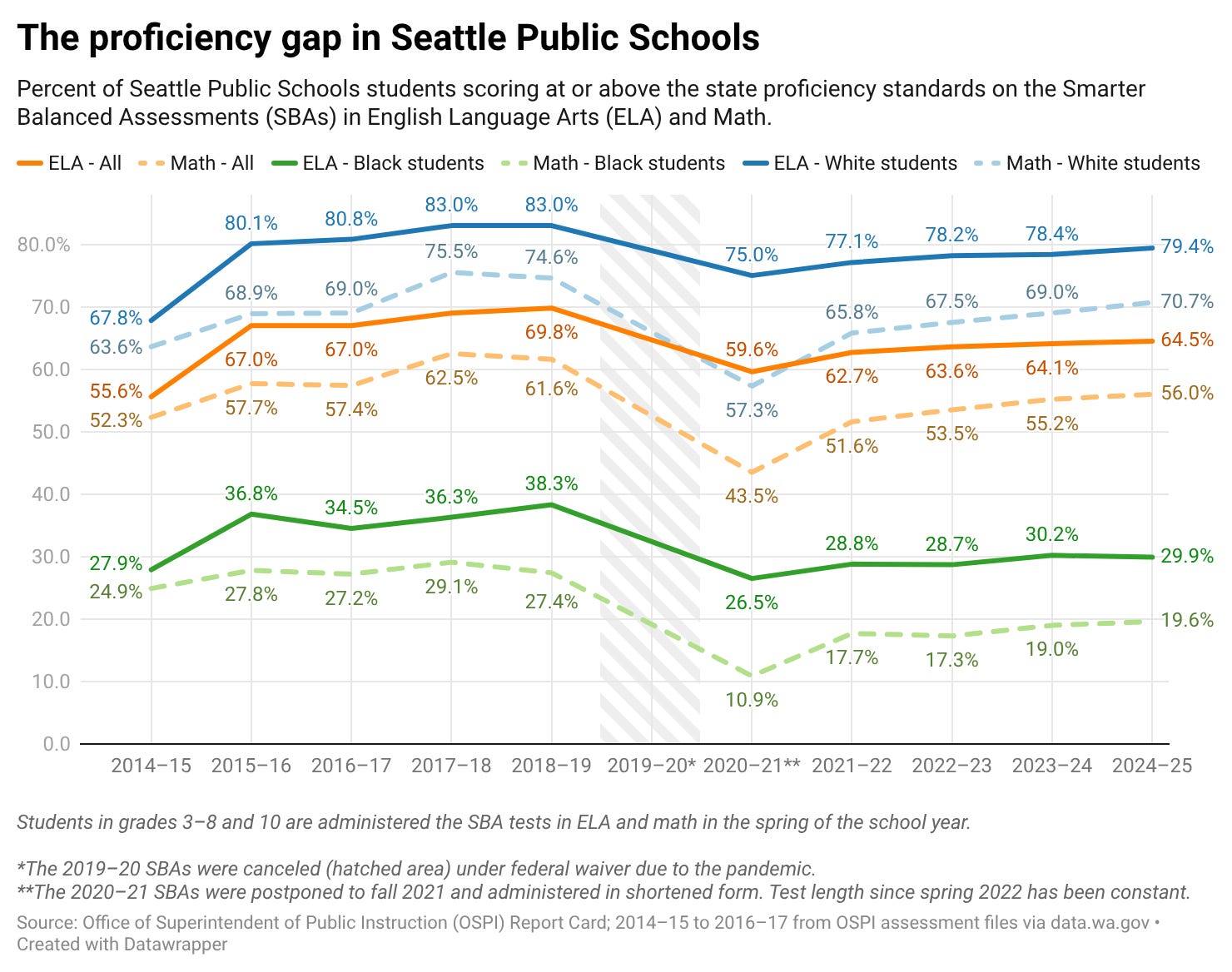
Between the 2019 and 2025 SBAs, the proficiency gap between white students and black students increased by 4.8 percentage points in ELA and a full 12.6 points in math. In addition, the achievement gap that Stanford analysts found in 2016 has only gotten worse. Based on state and national data, in 2025, Seattle’s black students now score 4.7 grade levels below their white peers in math and 5 full grade levels in reading:
Over the five years between 2019 and 2024 that this failing focus on black boys was the district’s primary educational concern, the school board or senior staff made almost no effort to interrogate why AAMA’s programs and strategies were failing to deliver the desired results. Instead, any mention of the widening achievement gaps was left out of the district’s reports and communications, which continued to tout the efforts being made as if they were actually accomplishing something meaningful. This was in keeping with SPS’s move away from doling out consequences based on performance and results-based metrics of the sort associated with the education reform era. What really took precedence now at SPS was making students feel more seen and welcomed, as opposed to setting academic expectations that might make them feel challenged or inadequate. As Castro-Gill put it in a 2020 essay, “Closing ‘Achievement/Opportunity’ gaps is a Western way of thinking about education. It’s linear and views students as lacking something and needing to be turned into some ideal, which is defined by white supremacy.“
Still, the district’s abject failure in its efforts to help black boys was plain to see for anyone who looked past the wall of happy talk. In January 2025 the school board quietly dropped its goals of raising the proficiency levels of black boys, again without making any effort to excavate why the previous five years of effort had failed.
NO COPS, BUT RISING SAFETY CONCERNS
As the intensive focus on making black boys feel like they belonged was not producing positive results — at least by the traditional, non-equity-based measures — other students and families were feeling short-changed. It had become glaringly obvious that district leaders were more interested in often performative social justice concerns than in improving educational quality in Seattle’s schools. Prolonged school closures during COVID significantly heightened those concerns — Seattle schools did not begin reopening until April 2021, with full-time in-person instruction for all students delayed to September 2021, about a year after many private and charter schools had reopened.
Safety too became a rising concern. In June 2020, the school board, citing its desire to demonstrate support for defunding the police, voted to remove Seattle police officers who had long been assigned to act as “School Resource Officers” (SROs) in five Seattle schools in higher-crime areas. This occurred over the objections of some minority parents, and despite the fact that these officers were often trusted mentors with long-standing ties to the school communities where they were deployed.
The district pulled SROs just when it might have benefited from having them. In the wake of the pandemic, Seattle was not spared from the national crime spike. In 2022, a student at Ingraham High School was shot and killed in the building while school was in session; in 2024 a student at Garfield High (where more than a quarter of the student population is black) was fatally shot during lunchtime in the school parking lot while trying to break up a dispute, and earlier this year two young black boys were tragically gunned down at a bus stop outside of Rainier Beach High School in a heavily minority, high-crime area of Southeast Seattle, among other serious criminal acts in and around Seattle schools.
Despite these developments, the Seattle School Board has remained staunchly opposed to restoring SROs in schools. In the wake of the Garfield shooting, which occurred in broad daylight in front of dozens of witnesses (the perpetrator remains at large), SPS surveyed school families about restoring a police officer assigned to the school. Among the respondents, a supermajority of the school community expressed support, as did the school’s principal, who is black. Despite this, in the face of pressure from progressive activists, last October the board voted down a proposed one-year pilot to restore an officer at Garfield by a 5-2 margin.
CURIOUSLY INCURIOUS ABOUT PLUNGING ENROLLMENTS
The stagnant test scores, loss of focus on educational quality, constricted opportunities, and rising safety concerns had real downstream impacts. Many parents, particularly those from more affluent backgrounds or with a greater focus on educational attainment, began looking at other educational options for their children. (Asian families in particular removed their children at higher rates.) SPS enrollment has dropped by more than 4,000 students since 2019, even as the city’s population grew by more than 63,000. The percentage of students born in the city who enroll in public kindergarten has fallen to 53 percent, a 19 percent decline since 2012. Meanwhile, private school enrollments have surged nearly 20 percent since 2019, with private schools now educating more than a quarter of Seattle’s children, the second highest percentage in the country.
John Hay Elementary in upper Queen Anne, an upscale neighborhood where the median home price is in the seven figures, became the poster child school for SPS’s disenrollment crisis. The school shed 200 students, nearly 40 percent of its total enrollment, between 2020 and 2022. In keeping with SPS’s penchant for ignoring bad outcomes and inconvenient truths, the district made no effort to determine why so many families were abandoning the school. One parent who had a child enrolled at John Hay at the time says that back in 2022, some teachers at the school were overemphasizing social justice and other identity-related instruction instead of spending time on basic academic and life skills, particularly in the lower grades. “Are kids in kindergarten really able to understand land acknowledgments?”
He clearly wasn’t the only one who found John Hay’s prioritizing of social justice activism over traditional learning concerning. At the time, almost no one complained publicly about this shift in emphasis except in coded ways; in that era, the social risks in Seattle of speaking up against identitarian equity strategies were very real, particularly for more affluent white or Asian parents. But wealthier parents reacted by quietly removing their children and sending them to private schools where they would receive a more traditional education. While the levels of disenrollment at John Hay may have been extreme, there was reason to suspect that parental disenchantment with the district’s curtailment of advanced learning and its preoccupation with identitarian leveling over maximizing the educational attainments of each individual child was widespread.
No one knew for sure, though. For years district leaders attributed declining enrollments to the city’s rising cost of living driving out lower-income families, as well as to the growing prevalence of remote work spurred by the pandemic. For several years they refused mounting public calls to actually investigate why so many families were leaving, which heightened suspicions that they knew that if they asked parents why they removed their children it would become unavoidable that their equity reductionist policies were spurring the exits. That changed in 2024, when the district finally capitulated and commissioned an enrollment survey of parents and caretakers of current and former students. The results, released publicly in January 2025, were both eye-opening and entirely predictable.
Just short of three in five parents and caretakers of currently enrolled students said they had considered disenrolling their children from SPS because of concerns about educational quality, while 44 percent cited the curriculum being taught as a concern. Another 42 percent cited the changes to HCC as something that had caused them to consider leaving. Among parents who had already removed their children, 57 percent cited the quality of SPS’s education as a major motivation for doing so, while 48 percent cited the curriculum being taught and 20 percent said they were majorly motivated to leave by changes to HCC. In an open-ended question asked of disenrolled parents about what would induce them to re-enroll their children, by far the most common answer (27 percent) was improving academic rigor. Cost of living in Seattle was a major motivation to leave for only nine percent of respondents.
By then serious damage had been done. SPS’s declining enrollment had exacerbated the district’s financial woes, which further worsened after district leaders ended a five-day teachers’ strike in 2022 by agreeing to a contract that the district lacked the revenues to support. Annual deficits towered at $131 million in 2023, $104 million in 2024, and $94 million in 2025, with the shortfall made up by district leaders cobbling together short-term band-aids, draining reserves and engaging in questionable borrowing. The perception of a district in perpetual crisis further eroded parents’ confidence in district leaders. Things may not have reached doom-loop levels of family flight, exactly — enrollment in Seattle schools held steady in 2024 — but SPS’s constant budgetary scrambling added to perceptions of a district that was seemingly careening out of control and either unwilling or incapable of getting its house in order.
A REBELLION IN THE PARENTAL RANKS
For years the equity-reductionist approaches pushed by progressive school board members and some senior staff received little media scrutiny and generated almost no public pushback. That began to change in 2023, as word leaked out widely in the SPS parent community that several board members, led by School Board Vice President Liza Rankin, who had replaced Chandra Hampson as the leader of the board’s identitarian-progressive wing, were laying the groundwork to close a large number of Seattle schools.
In the summer of 2023, then-Superintendent Brent Jones began convening a series of “well-resourced schools community meetings” with the ostensible purpose of gauging the sentiments of parents and other stakeholders about what they were looking for in their local schools. But the real meaning of “well-resourced schools,” in the deliberately obfuscatory, borderline Orwellian parlance of the district, was to socialize the idea that district resources were stretched too thin across too many schools and therefore the district would be better off consolidating students in fewer, larger locations. That this was the district leadership’s way of setting the precedent for a major round of school closures was not lost on those paying close attention.
In September 2024, Jones finally surfaced what by then had become Seattle’s worst-kept secret. He proposed shuttering up to 21 schools, about a fifth of all of the public schools in the city (and more than a quarter of its elementaries and K-8s), arguing this was a necessary step towards addressing the district’s budget shortfalls. The backlash from parents was immediate and only grew after it quickly became apparent that the bulk of the schools slated for closure were the district’s “option schools,” which offered alternative curricula like STEM instruction or language immersion programs. As it happened, these schools were also the most popular schools in the district; in fact, the ten schools with the longest waiting lists to get in were all listed on the closure chopping block.
But for Rankin and her allies on the board, these schools were bastions of privilege and engines of inequity. (It’s also worth noting that many of the Seattle schools with the highest levels of Asian enrollment were targeted for closure.) Closing them would concentrate more resources into neighborhood schools with higher black and brown populations, the thinking went, and teaching all children under a one-size-fits-all approach would help to equalize outcomes. As Seattle Times columnist Danny Westneat wrote about the district’s targeting of these schools, “Because you have to choose to go to an option school, and then apply, many families don’t. Rather than help them navigate this system, or open up additional intriguing options, the district appears to be heading instead toward uniformity.”
The surfacing of the school-closure plan turned into a galvanizing moment for frustrated and increasingly organized SPS parents. They saw through the district’s flimsy justifications that these closures were driven by economic necessity rather than its determination to shutter the schools they saw as catering to privileged children and siphoning resources from minority children (this despite the reality that the option schools tend to cost the district less per pupil than regular schools). As the backlash grew, and some parents initiated an effort to recall Rankin (the allegations in the recall petition were later deemed legally insufficient by a judge), for the first time school board members (and former members) publicly broke ranks with the board’s equity-reductionist wing, decrying the closure plan and the district’s questionable policies and pedagogical approaches more broadly.
Within three months, SPS first backpedaled, reducing the closure list to four schools, then ultimately withdrew the plan entirely. That did not stem the criticism, however. The dam had finally burst, and emboldened members of the board continued to call out the lack of accountability and poor leadership within the district. The fallout from the school closure fight fundamentally shifted the balance of power in the upper ranks of SPS. Rankin was replaced as president of the board in December 2024 by Gina Topp, a less ideologically hardline member with a more conciliatory approach towards board management.
HARRISON BERGERON EXITS STAGE LEFT
After Jones’s departure and a long period with an acting superintendent, the district’s fourth superintendent search since 2014 led to the selection of Ben Shuldiner, who took over the reins at Seattle Public Schools at the beginning of February. Shuldiner immediately offered a sharp change of tone. An outsider to the district, the energetic, blunt-talking New Yorker (who self-describes as strongly progressive) is a magna cum laude graduate of Harvard who had become the youngest high school principal in New York state history. Most recently he oversaw the schools in Lansing, Michigan, a district about one-fifth the size of Seattle’s, where he significantly increased enrollments, attendance, test scores, and graduation rates.
This sort of equity reductionism, Shuldiner admits, is the path that SPS has followed. “We made a really big tactical mistake by lowering standards rather than raising standards.”
In a bracing contrast to SPS’s usual diet of platitudes, deflections, and cold-shouldered dismissals, Shuldiner launched his tenure with a series of public appearances and community and stakeholder meetings where he forthrightly acknowledged that the performance of SPS was subpar and things would need to change — dramatically. He invited dissident parents to join him for collaborative work sessions to reimagine how the district is administered and structured. And in his public comments, including a public conversation with me in February, he has been a raging bull in the china shop of Seattle’s progressive-identitarian sacred cows, saying SPS has misconstrued its approach to equity and has enabled a culture of complacency and a lack of accountability.
When asked about the district’s equity approaches, he routinely cites the 1961 Kurt Vonnegut short story “Harrison Bergeron,” which imagines a dystopian future world where the state enforces equality of outcomes by suppressing individual talent and handicapping higher achievers: beautiful people are forced to wear ugly masks, athletic people are saddled with weights to limit their physical prowess, and so on. This sort of equity reductionism, Shuldiner admits, is the path that SPS has followed. “We made a really big tactical mistake by lowering standards rather than raising standards,” he said in a recent public appearance, and told the Seattle Times that SPS has exemplified “the soft bigotry of low expectations” towards “our BIPOC and multilingual students,” while “accepting and excusing low performance rather than owning it.” Asked how the district could do a better job of educating those students, he has a succinct answer: hold people accountable.
Beyond hiring a change agent like Shuldiner, the Seattle School Board has taken other recent actions that indicate a willingness to reset its approaches. In February, the board began dismantling its widely criticized Student Outcomes Focused Governance (SOFG) framework that had been championed by its identitarian activist wing and formally adopted in 2021. SOFG, with its rigid approach to delineating board responsibilities and focus that led to the elimination of standing committees (including the committee overseeing the district’s budget), fewer public board meetings, and inattention to issues of concern like school safety, had engendered widespread criticism. Perhaps most encouraging of all on the curricular front, in April, after an 18-month study process, SPS formally adopted a phonics-based “science of reading” curriculum for K-5 students, cementing its decision to move away from the “balanced literacy” whole-word recognition approach that had been entrenched in many blue jurisdictions.
Is a full-scale course correction for the Seattle schools in the offing? Superintendent Shuldiner is telegraphing further major changes, but it remains to be seen whether he will actually have success in restoring a culture of accountability and performance to Seattle’s public schools. Can he deliver equity the right (but much more difficult) way, by raising up those who are falling behind rather than holding back higher performers? Hard choices loom large, and while his call for a sharp change in direction has mostly been well received so far, the fraught, racially charged politics of Seattle’s school district will not be easy for an outsider to negotiate, and an anti-accountability backlash is certainly possible. In our February interview Shuldiner told me, only half-jokingly, “Either I’m going to be here 10 years or I’m going to be gone in six months.”
A BROADER LESSON FOR BLUE AMERICA
In some ways Seattle is an outlier city: it is a far richer, more educated, and even bluer city than most other big blue American cities. It is also a majority-white city, one more in tune than most with the latest trends in progressive cosmopolitan culture. As such, Seattle’s public schools have become a proving ground for latter-day progressive pedagogical experimentation.
But the same trends that have reshaped public education in Seattle have also been reshaping public education across urban America over the last decade. The portrait above of the wrong turn taken by Seattle Public Schools looks much like those that could be painted in countless districts across the country, just with bolder brushstrokes.
So if what happened in Seattle is broadly reflective of educational trends beyond the city’s borders, then it’s important to admit plainly that the people who were in charge of Seattle’s schools over the last decade failed. They promised that rebuilding Seattle’s schools on a foundational culture of identitarian belonging would address the many shortfalls and mistakes of the education reform era, and that a turn towards equity reductionism would deliver “educational justice.” They were wrong, in some cases spectacularly and embarrassingly so. But that they failed to deliver what they promised does not mean that they didn’t care.
They did care about Seattle’s kids. They cared about encouraging Seattle’s children to advocate for bolder action to combat climate change. They cared about making sure black and brown and gay and trans children across Seattle feel like they belong in the mainstream of their school’s culture, that they feel validated in their identities and connected to their communities. They cared that Seattle’s children demonstrate fluency in the cultural codes and cues that mark upscale, educated cosmopolitanism. They cared that no child feels like they aren’t good enough, or that they are less capable, or a failure. They cared that society’s structures and institutions — especially its public schools — do not oppress or mistreat children from underprivileged backgrounds. They cared deeply about all of those things, and many others. They just didn’t care nearly as much about the basic education of Seattle’s children.

It's beyond frustrating to watch SPS (and its supporters) be so completely unwilling to examine what is/isn't working, and to change course. For the most part they hand-wave, blaming "lack of revenue", or attempt to distract with culture-war stuff about GOP/red-state education. Meanwhile there are places improving outcomes (including for poor & minority kids) by focusing on basic academics, and doing so at a much lower cost per student.
The current approach feels almost religious, where policies & programs are treated as "articles of faith" and worse results don't change anyone's minds. SPS claims to care about reducing educational gaps and improving student outcomes, but then measure themselves via how many new roles are created, how many initiatives/programs have been launched, etc. It's like "vanity metrics" in tech.
Hopefully Shuldinger can re-focus SPS' programs and spending on outcomes, as he said in his last communication. But there are a LOT of institutional & political headwinds to getting there.
> But that they failed to deliver what they promised does not mean that they didn’t care.
Your last paragraph neglects what I think might be the most important lesson for future reformers: caring *isn’t enough*. The root error under this whole school of progressive pedagogical theory (and a lot of other progressive ideas) is the assumption that caring — or rather, Caring™️, as part of the Being A Good Person™️ package — is all that matters. If someone in the Good Person™️ club must admit that Seattle was a failure, the easiest path by far will be to chalk it up to “they must not have Cared™️ enough” and double down.